
Morocco is unlike any other country that I have ever visited before. Uniquely located between the southernmost tip of Europe and Africa and with a large Arab population as well as an indigenous Amazigh population. Morocco is a melting pot of cultural influences. The Amazigh make up roughly a third of the nation’s population, and their presence extends across Algeria, Tunisia, and Libya. In Morocco, the Amazigh mostly reside in the central, partly mountainous region of the country. The Arabs (67%) first started arriving in the 7th century AD and currently live more around the western and eastern rims of the country.
If you’ve ever met a Moroccan tour guide, you’ll probably know that Moroccans are no strangers to speaking multiple languages. Nearly all of the 37 million inhabitants speak Moroccan Arabic, while the Amazigh speak various languages under the Tamazight umbrella. French is also commonly spoken due to the French colonisation (1912-1956) and serves as the lingua franca with the outside world. English is not yet as widespread, as I discovered firsthand, although I did meet some young people who spoke English fluently. The Islam is enshrined in the constitution as the official state religion, and 99% of Moroccans are Muslim.
No drones
Drones are strictly prohibited, so leave them at home (they will check every bag). I had to leave mine at the airport, which also meant I had to unexpectedly depart from the same airport.
Marrakesh
مراكش
After a fairly eventful flight from New York, nothing could have fully prepared me for my first arrival in Marrakesh (Marrakech in French/Spanish, or Mṛṛakc in the Tamazight Latin alphabet). Being dropped off from the airport at the bustling Djemaa el-Fna square on the edge of the old medina (city), it’s hard to know where to look. Senses are easily overloaded as a mixture of food stalls, acrobats, snake charmers, game hosts, musicians, and lamp sellers all compete for attention. Walking deeper into the maze of the old medina, I was introduced to the souks, where vendors constantly and dutifully call out to any passerby to attract attention to their goods and services. As the lanes start to become narrower, the activity increases. Add the occasional motorcyclist and donkey wiggling their way through, and you may have an idea of what it’s like to navigate these lanes.

A souk (market) in the centre of Marrakesh just after sunset.
Even though the square clears up during the day, the souks in the medina do not. However, in my search for authenticity, I frequently wandered away from the souks. This was not always appreciated by the locals. I noticed an invisible perimeter around the souks; outside this boundary, locals would often remind me that the “souks are that way.” In other instances, they would first build rapport and share a bit about the local history before leading me to a friend’s shop. I was in completely different world where I did not know the rules and I felt like a fish out of the water. This was going to take some time to learn about the local ways.
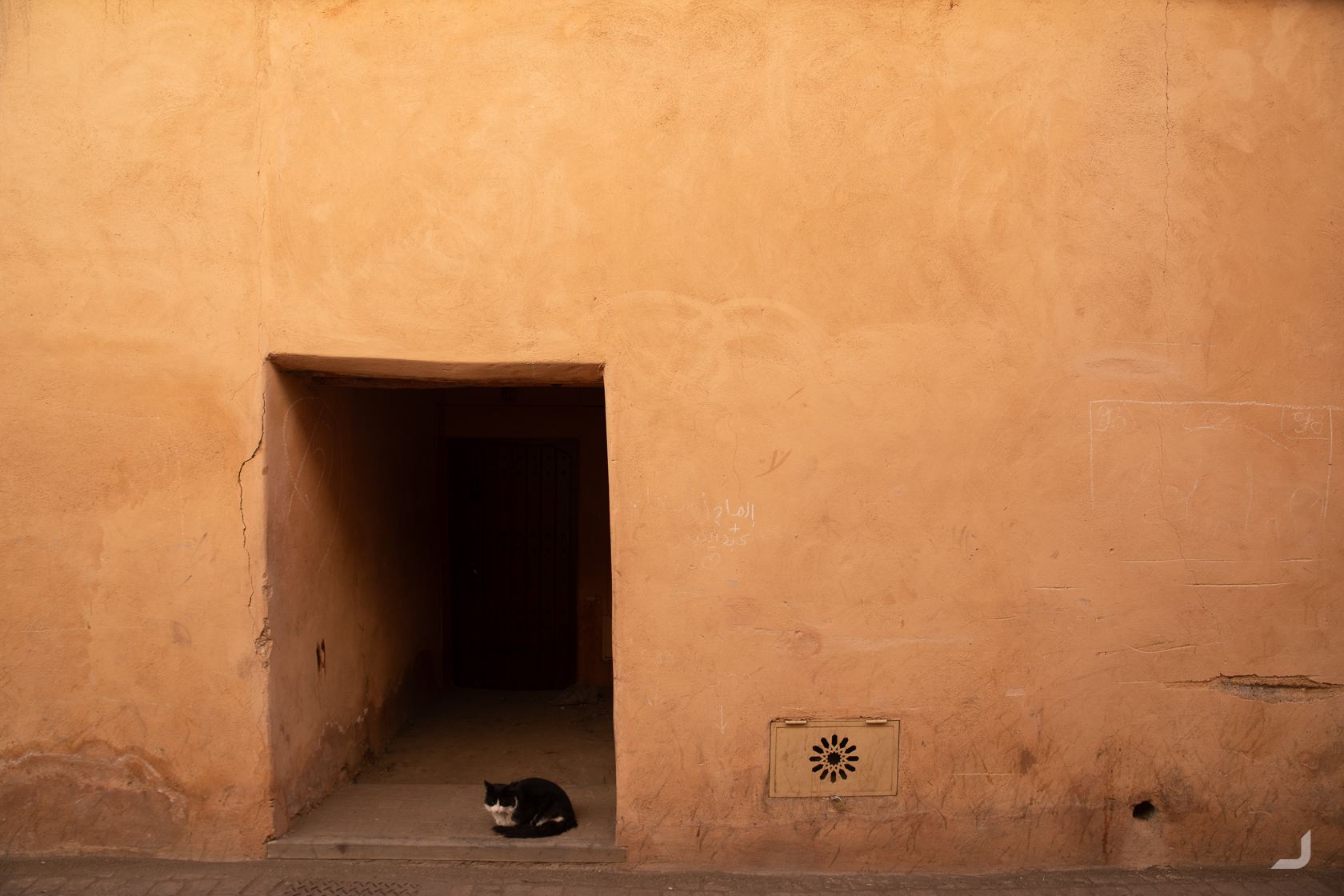
A cat in front of a sabaat, a passage that leads to another part inside the old Medina in Marrakesh.

A sabaat often creates a sense of mystery as they lead to another narrow, winding lane within the maze-like structure of the old Medina in Marrakesh.
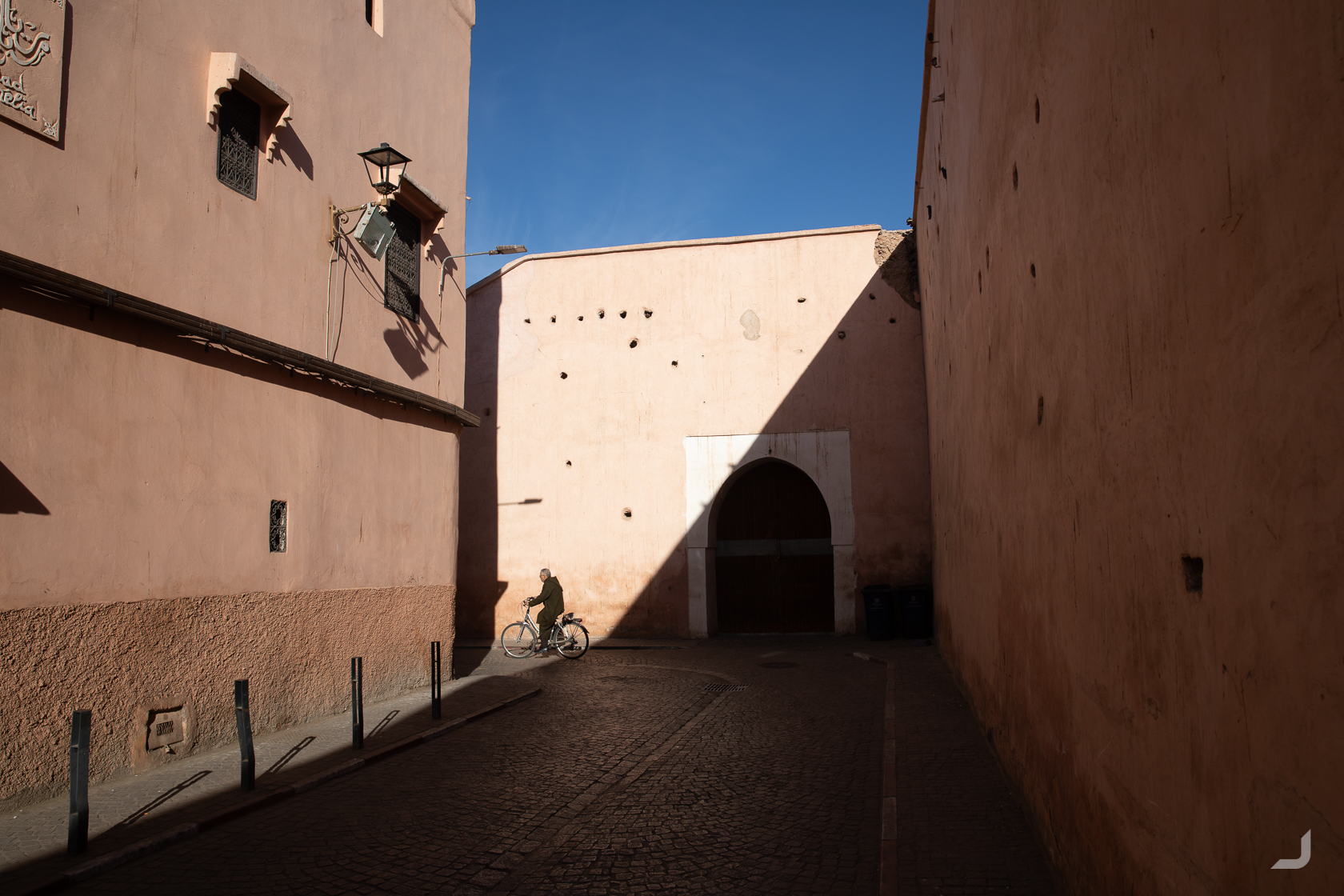
A cyclist passes one of the many walls inside the medina in Marrakesh.
The endless walls of the medina typically rise several stories high, with countless meters of tadelakt (plaster) interrupted only by the occasional door, window, or tiny ventilation hole. Even though my hotel was just a stone’s throw from the square, closing the hotel door behind me instantly blocked out all the noise and made me believe that I had entered a portal to another world. A tiny yet glorious riad (inner courtyard) with marble floors, arched doorways, and a dimly lit fountain at its center had successfully convinced me that I was now inside a Disney movie.
No photo
Most people did not want to be photographed. The mere gesture of lifting up my camera was often enough to provoke an immediate and loud reaction of disapproval. Hence, most photos contain people whose faces are not visible. In the odd picture where a face is visible, clear approval was given by the subject.
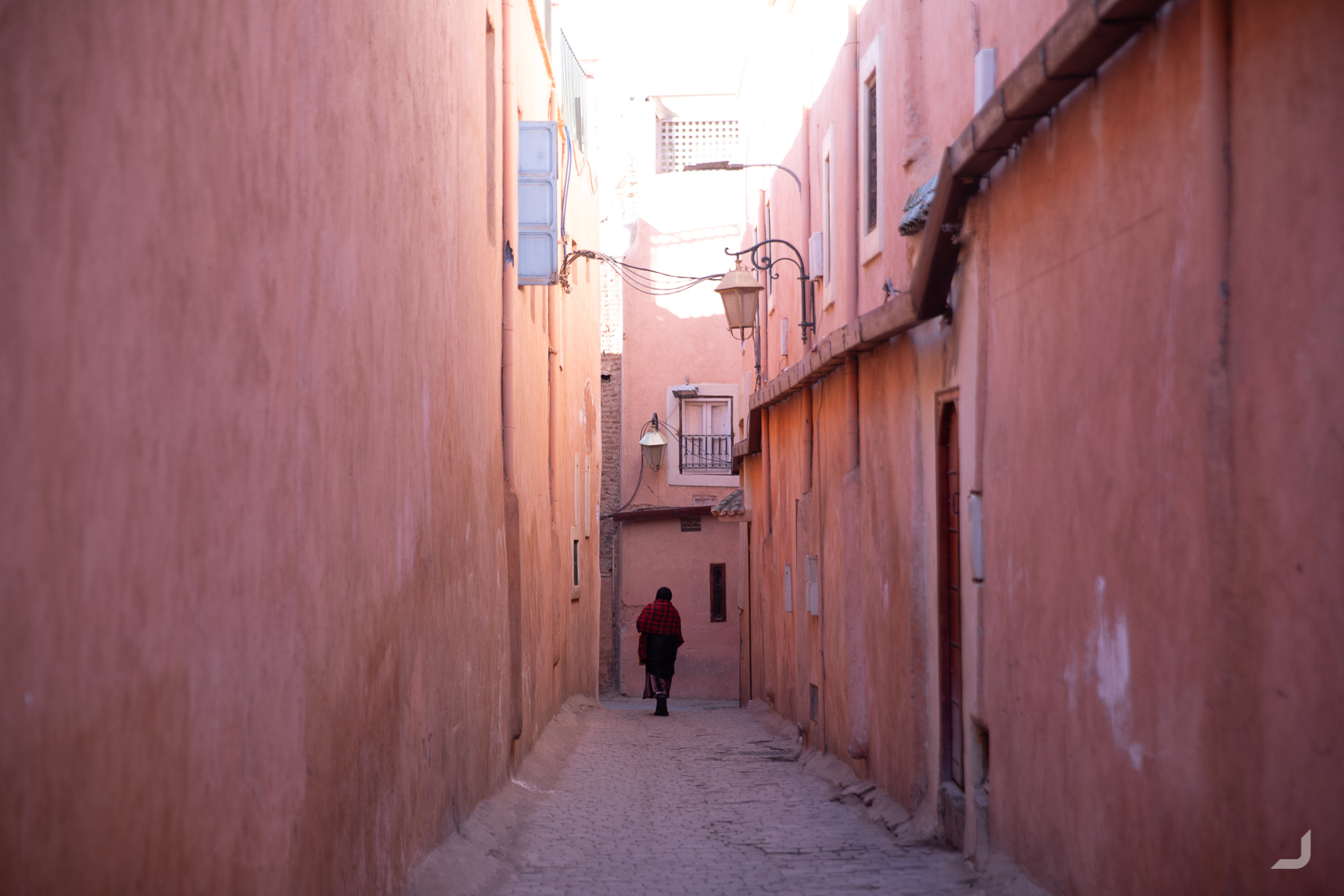
A woman walks through one of the many lanes inside the medina in Marrakesh.

A man and a woman walk through the jewish quarter in Marrakesh.
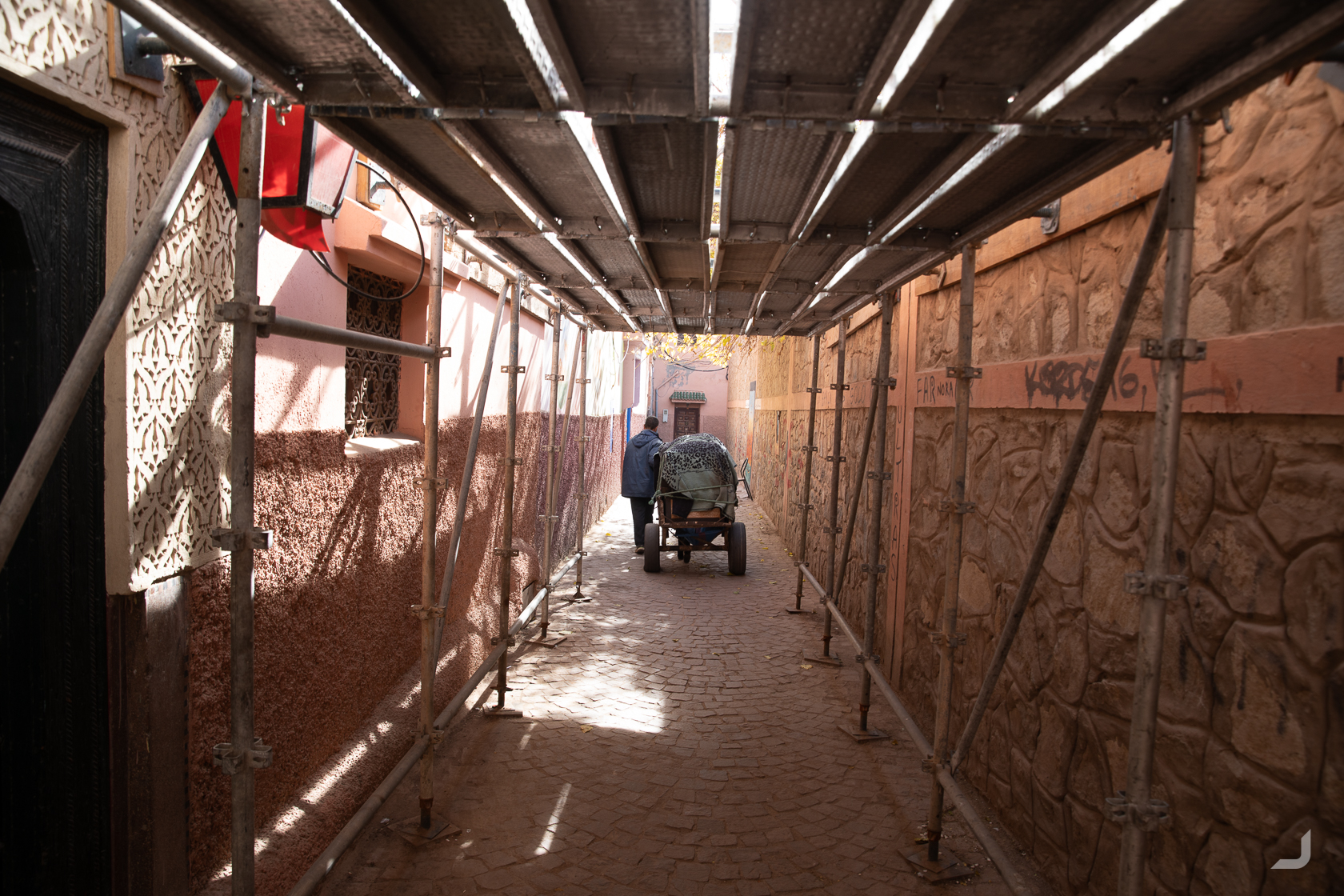

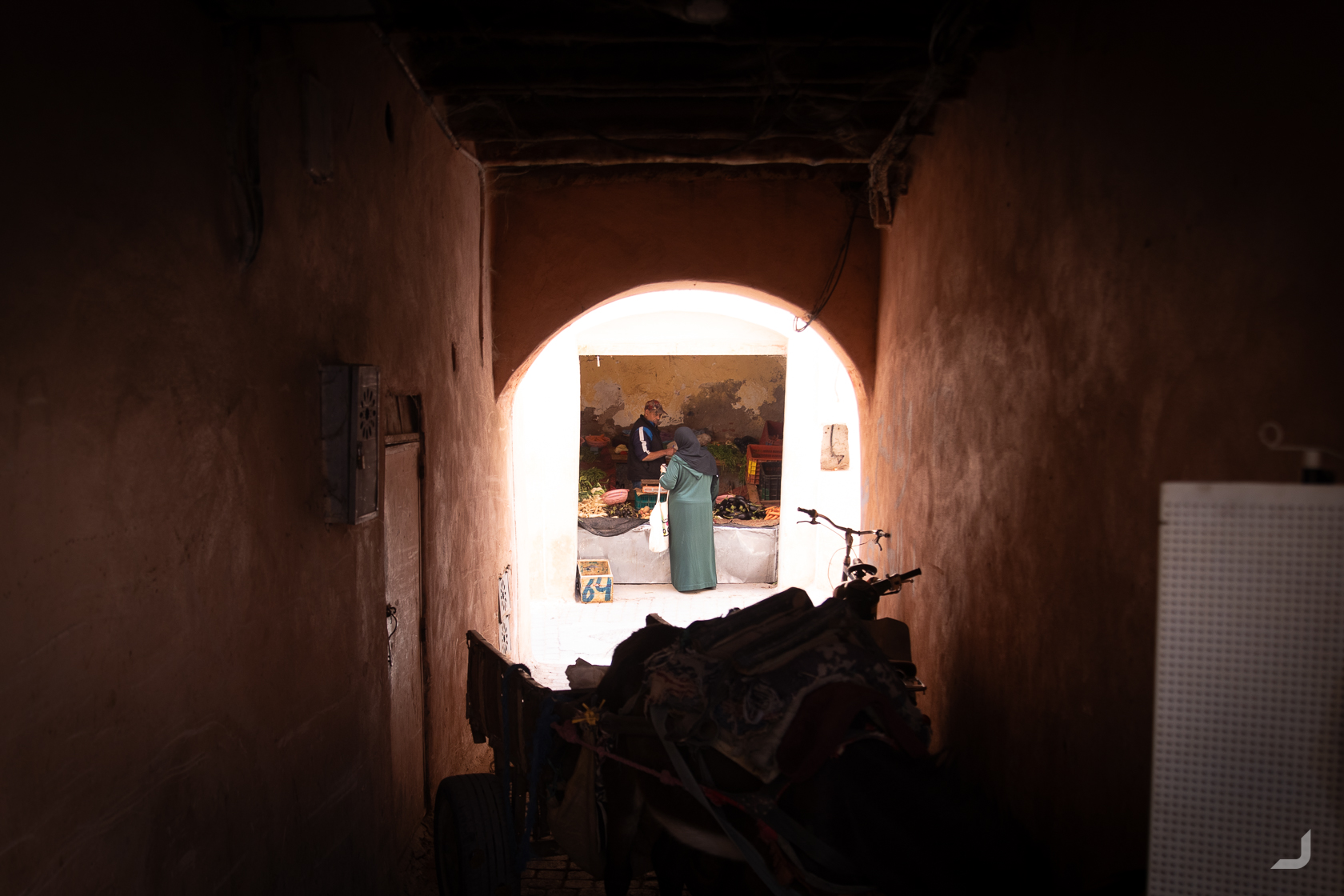

Daily life inside the medina in Marrakesh.
Ben Youssef Madrasa
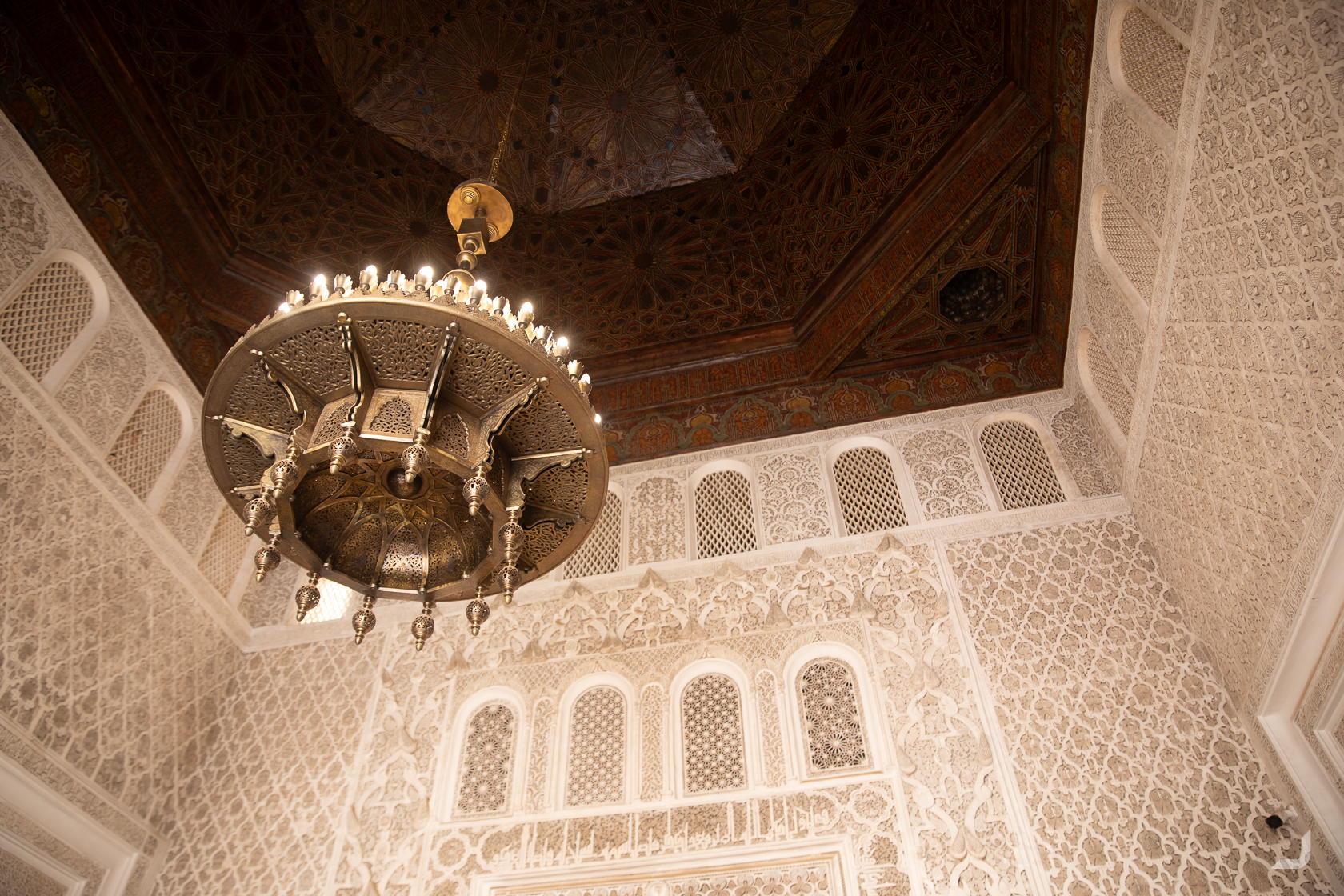
The Ben Youssef Madrasa is an Islamic school turned museum that was founded in the 14th century. If you can manage to overlook the tourists—it’s quite popular—the intricate stucco work, carved wooden ceilings, zellij (mosaic tilework), and courtyards with marble floors will effortlessly make you believe that you’re in a different world in a different age.


-
Naafidha
Morocco

The interior of the Ben Youssef in Marrakesh, an ancient school for students of the Koran.

A woman sells hand carved wooden animals in front of the Ben Youssef school in Marrakesh.
Bahia Palace and surroundings
The first part of the Bahia Palace was built in the late 19th century to serve as the residence of the vizier Ba Ahmed. Later it served as the residence of the French general during the French colonisation. Then it belonged to a few more royal sultans before it eventually became a national monument.

Zellij (mosaic tilework) inside the Bahia Palace in Marrakesh.

The inner courtyard inside the Bahia Palace in Marrakesh.


Doors and doorways in the Bahia Palace, and throughout Morocco, frequently have an arch that is representative of Moroccan and broader Islamic architecture. Arches are often seen as a symbol of the gateway to the divine, representing the transition from the mundane to the sacred. It also efficiently distributes weight, allowing for the construction of large, open doorways that can support heavy structures and allow for better airflow.
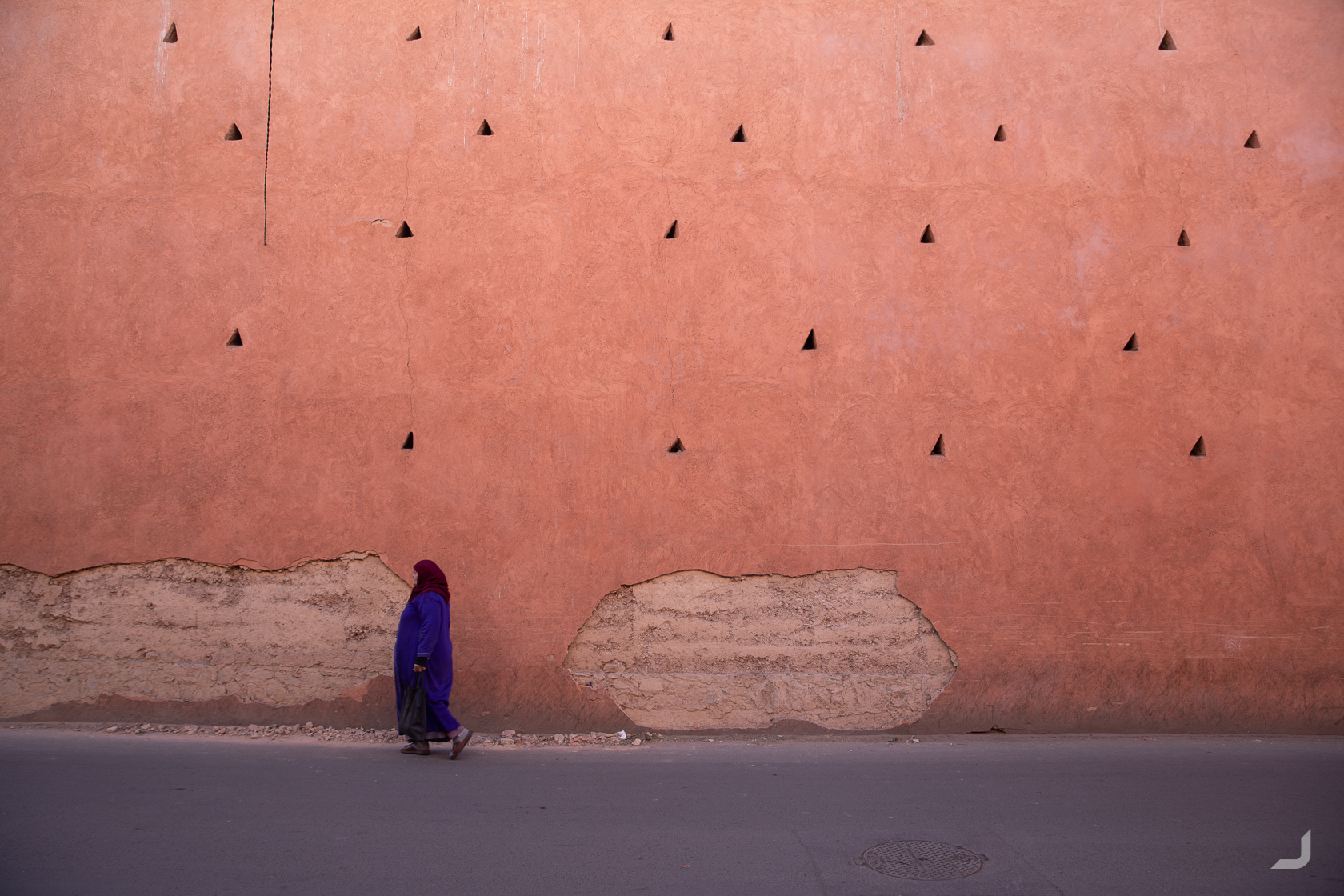
A woman walks past the walls of the ruins of the El Badi Palace in Marrakesh. The palace was built in the late 16th and commissioned by the sultan Ahmad al-Mansur of the Saadian dynasty. The tiny holes are left overs from the wooden blocks that were used as scaffolding. They also help to absorb the contraction and expansion of the wall due to temperature changes.
Exploring the outer suburbs of Marrakesh provides a bit more insight in regular Moroccon life amongst the medina.
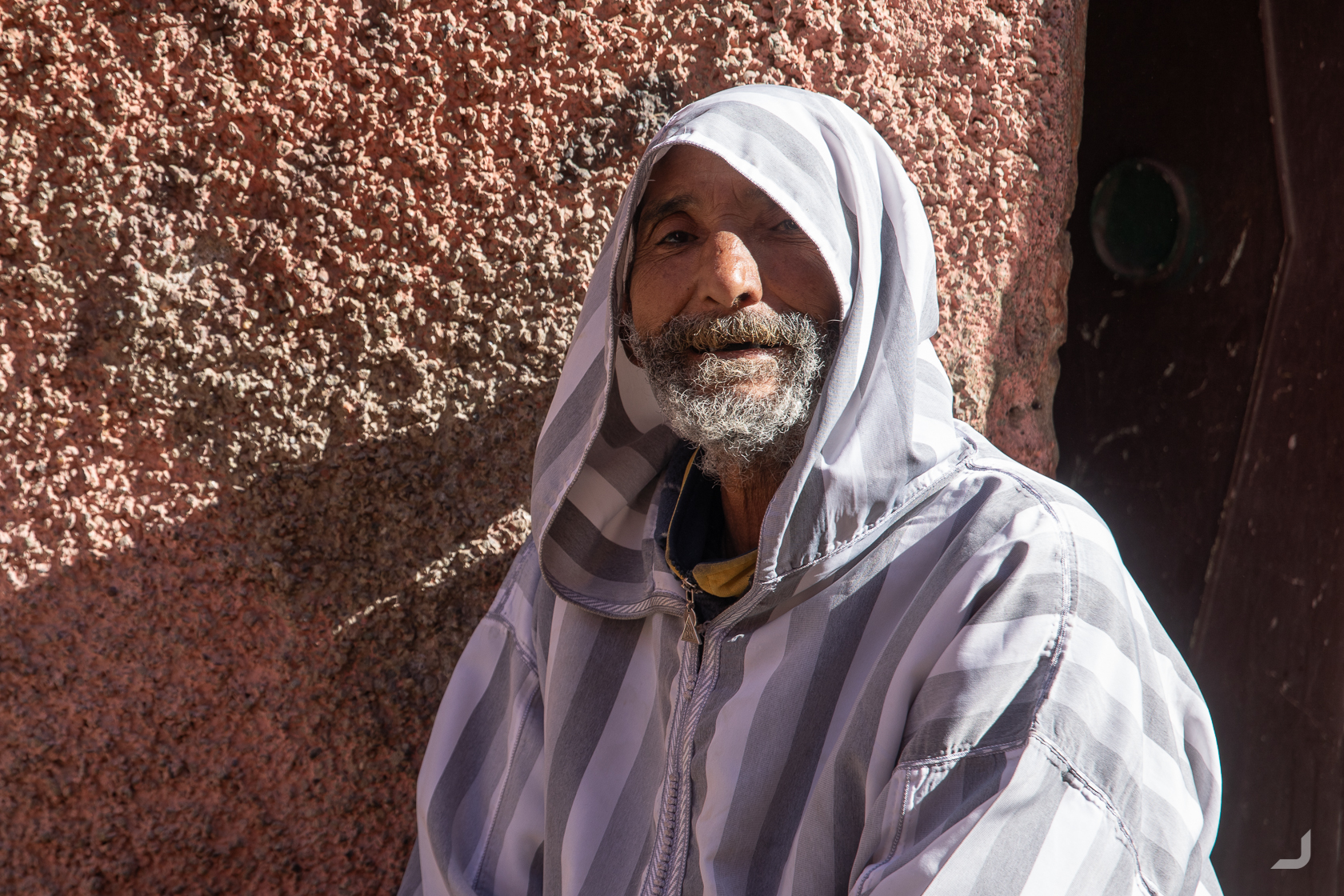
A man sits in front of his house in the Assouel area in Marrakesh.

Children gather inside the medina in Marrakesh.

One of the many cats, soaking up the sun inside the medina in Marrakesh.

People walking past the walls of the Bahia Palace in Marrakesh.

A woman inside the medina in Marrakesh.
Hostel Life
Arriving at a hostel just after midnight, I stepped into a cramped, dimly lit 6-bed dorm, hoping for a quiet place to rest. Instead, I was greeted by a man in his late 60s who was sitting on his bed, casually munching cereal straight from the box, while another, tangled in a web of cables and devices, was intermittently grumbling about the noise. Two others were snoring so loudly it made my bed shake. Just when I thought it couldn’t get any worse, a fifth man arrived, turning the snoring ensemble into a trio.
Sleep seemed impossible. I reached for my AirPods to turn on the noise cancellation. At that point I realised I had left them at the previous hostel. Again. I had just picked them up from the previous place after I had left them there too. I had no excuse. All I could do now is think about what I had done, again, under the sound of what 5 elderly men make at night.

The skyline of Marrakesh, overlooking the medina and the minaret de la Koutoubia.
Thinking of taking a tour?
If you’re looking to take a tour from Marrakesh, it might be worthwhile to shop around a little. Most tour agencies are all selling the same tours, although at greatly varying prices. The lady at my hostel explicitly told me to go somewhere else as she didn’t agree with the price her boss was charging. Most of these agencies offer a “deluxe” version for a substantial increase in price, where the only difference is the hotel, everything else is still the same. If you had gone for the higher price tier (almost double), there is a chance that you will have to stay in the more expensive hotel by yourself, as happened to a guy on our tour. He ended up missing out on communal dinners and board games with locals in our less expensive – but still great – hotel.
In hindsight, if you speak a bit of Arabic, Tamazight or French, a car or local transport might still be the best way to get around. If not, and if you travel solo and don’t mind being ushered through shops, the cheapest tours are hard to beat in terms of price.
The tour I found (2 nights – 650 MAD) took us to the Dades Valley via Aït Benhaddou before continuing onwards to Merzouga, a famous desert town in the Sahara nearing the border with Algeria.
Aït Benhaddou
آيت بن حدّو
A UNESCO heritage site since 1987, Aït Benhaddou is a historic ksar that is located along the former caravan route between the Sahara and Marrakesh. It has been fortified since the 11th century during the Almoravid period and has served as the backdrop for many movies, including Gladiator, The Mummy, Alexander, Kingdom of Heaven and Babel.

Aït Benhaddou is a historic ksar that is located along the former caravan route between the Sahara and Marrakesh.
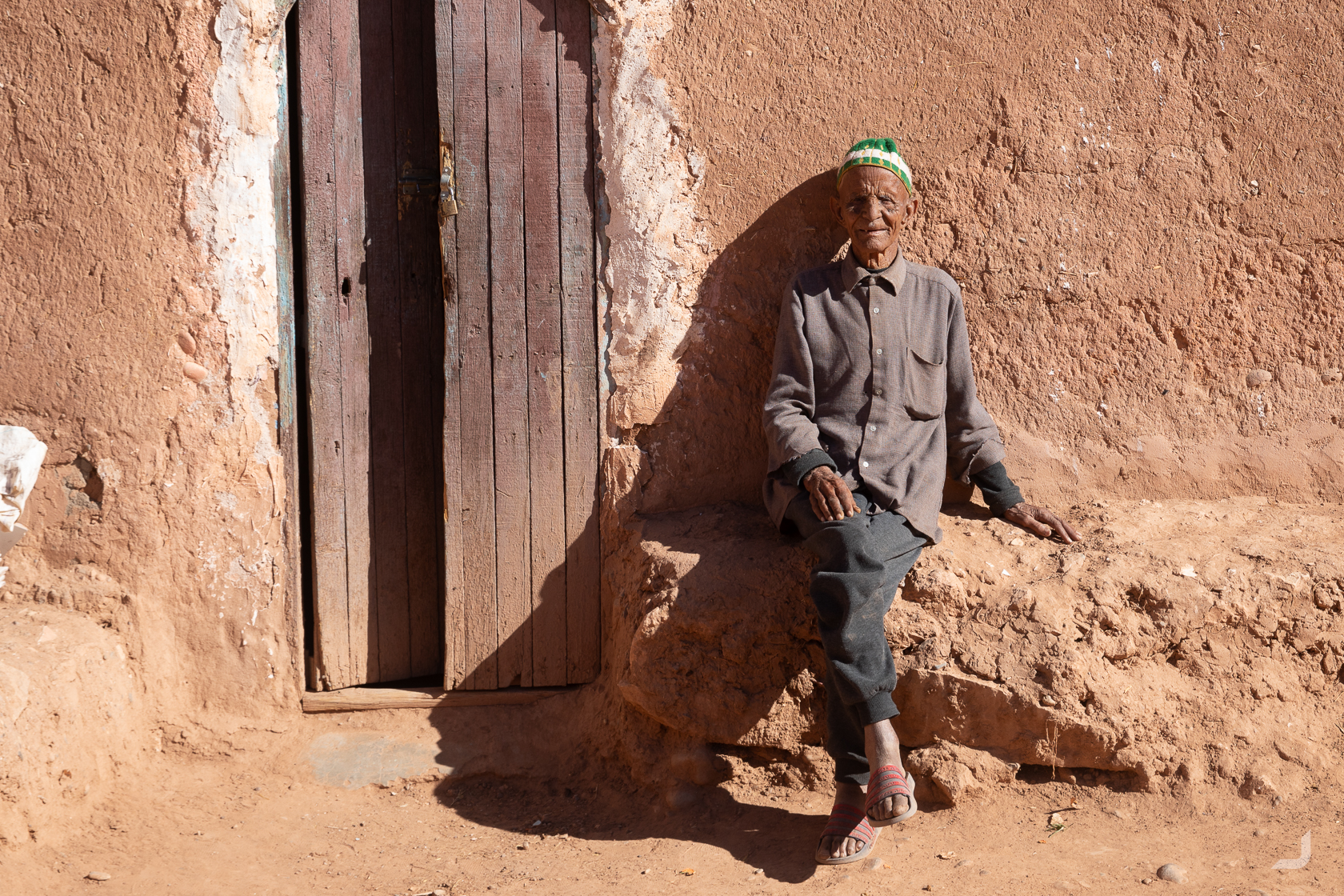
A man in front of his house in Aït Benhaddou.

The view from a hole in the wall on top of the hill at Aït Benhaddou.
Navigating shops on tours
There is a high possibility that you will be guided to many restaurants and shops on your tour. The booked restaurants charge high prices and because there is an arrangement between the restaurant and the tour operator, tour guides do not like it if you go somewhere else. However, keep in mind that you can. There might be a restaurant just next door charging one tenth of the price and being very grateful for your visit.
Another highly effective sales tactic is a visit to a scarf shop leading up to your desert visit. Your tour guide will tell you that a scarf is “the passport to the desert”, implying that buying a scarf is a prerequisite. Scarfs are certainly handy, however the camel ride is only a couple of minutes long and you are welcome to wear your own garment. Or again, there may be another shop just around the corner where you can help to spread the wealth amongst other locals.
Merzouga
مرزوكة
Merzouga is a popular destination for those wanting to visit the Sahara desert. It’s located in the far east of Morocco near the border with Algeria.

The desert dunes in Merzouga at sunset.

Berber tents at nightfall.
Visiting Merzouga on a tour
As part of the tour, visitors can opt in to ride a camel from the drop off location to the “berber” tents to stay the night. There are multiple of these tent villages spread out, each with their own communal tent and a campfire with music and dance. Each sleeping tent has 4 beds that gets filled up hostel style (unless you pay for your own) which are separated by gender.
The following morning we were able to choose between a camel ride back to the main road and visiting another berber tent closer to the Algerian border in combination with sand boarding (for a small extra fee). I chose the latter so that I could have more time to take photos. It turned out that there was only one sand board that had to be shared with about 15 people.
The tours are well oiled machines turning over a high volume of tourists like clockwork. While this batch of tourists is being transported over here, another batch is transported over there. Again, if you prefer a more serene experience it may be best to organise your own private trip.

Visitors depart from the berber tents on camels in Merzouga.

The desert dunes in Merzouga are large and impressive, although the combination of human activity and a lack of wind leave an abundance of footsteps and tyre tracks.

A tour guide transports a caravan of camels in the desert at Merzouga.
“Tips are not included”
While the journey from Marrakesh to Merzouga was perviously broken up into two days, the final and third day was impressively driven back to Marrakesh in one day by a rather silent driver who let the driving do the talking. This in combination by not repeatedly announcing that “tips are not included” (like some tour guides and restaurant owners) ironically earned him a substantial amount in tips.
Back in Marrakesh I found out that to get to other cities using public transport, there are two bus companies that make it relatively easy to book online: Supratours and CTM. I booked my bus to Essaouira, a coastal town east from Marrakesh that is also a popular surfing destination.
Essaouira
الصويرة
Essaouira, pronounced Ess-way-ra, is a small coastal city located directly west from Marrakech. Its inner medina is a UNESCO heritage site and it is surrounded by an impressive fortified wall.

The fortified wall surrounding Essaouira’s medina at sunset.
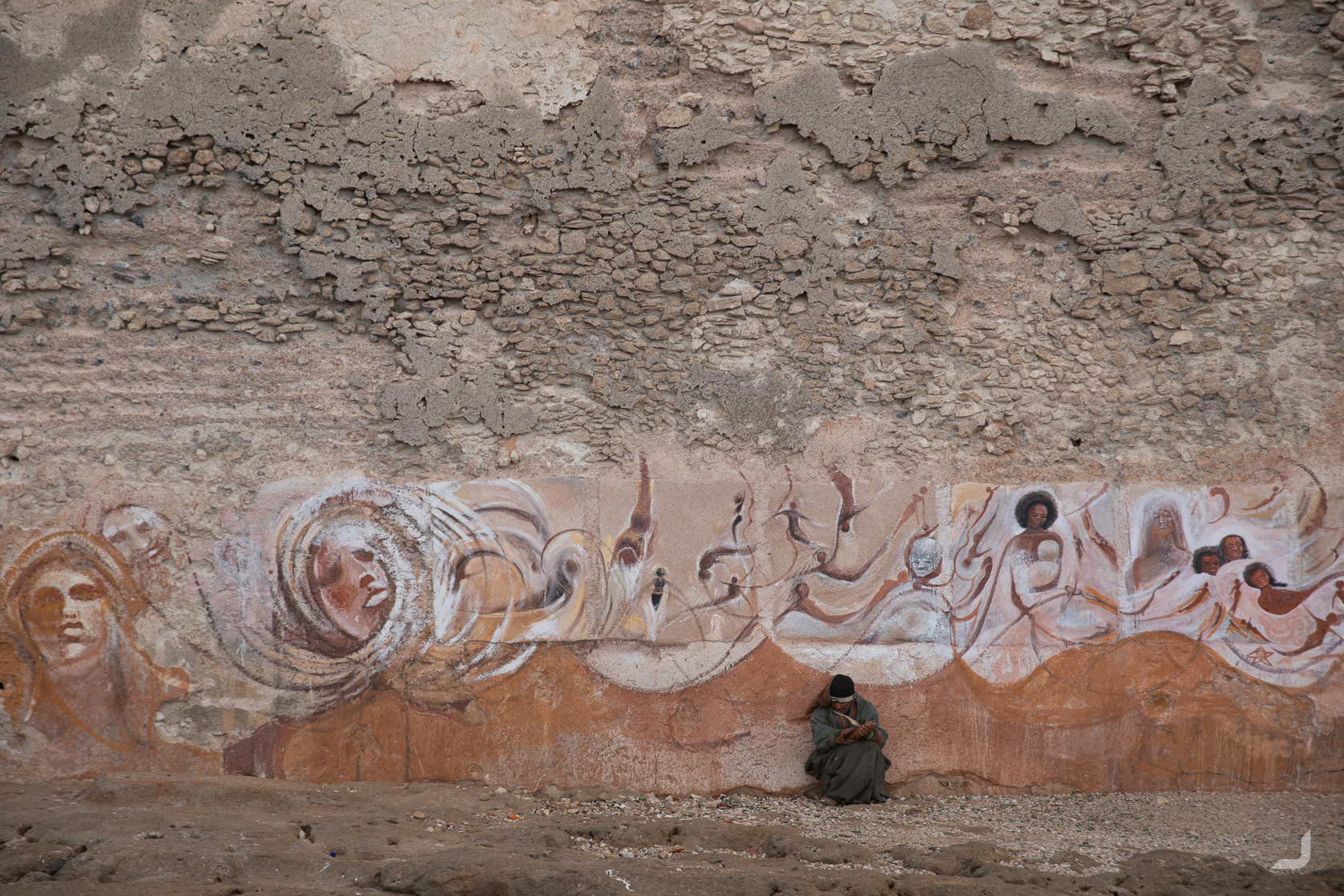
A man looks through sea shells in front of the fortified wall along the coast in Essaouira.

A man walks underneath the Bab El Marsa towards the fishing port.

The fishing port at Essaouira is filled with blue fishing boats and activity.
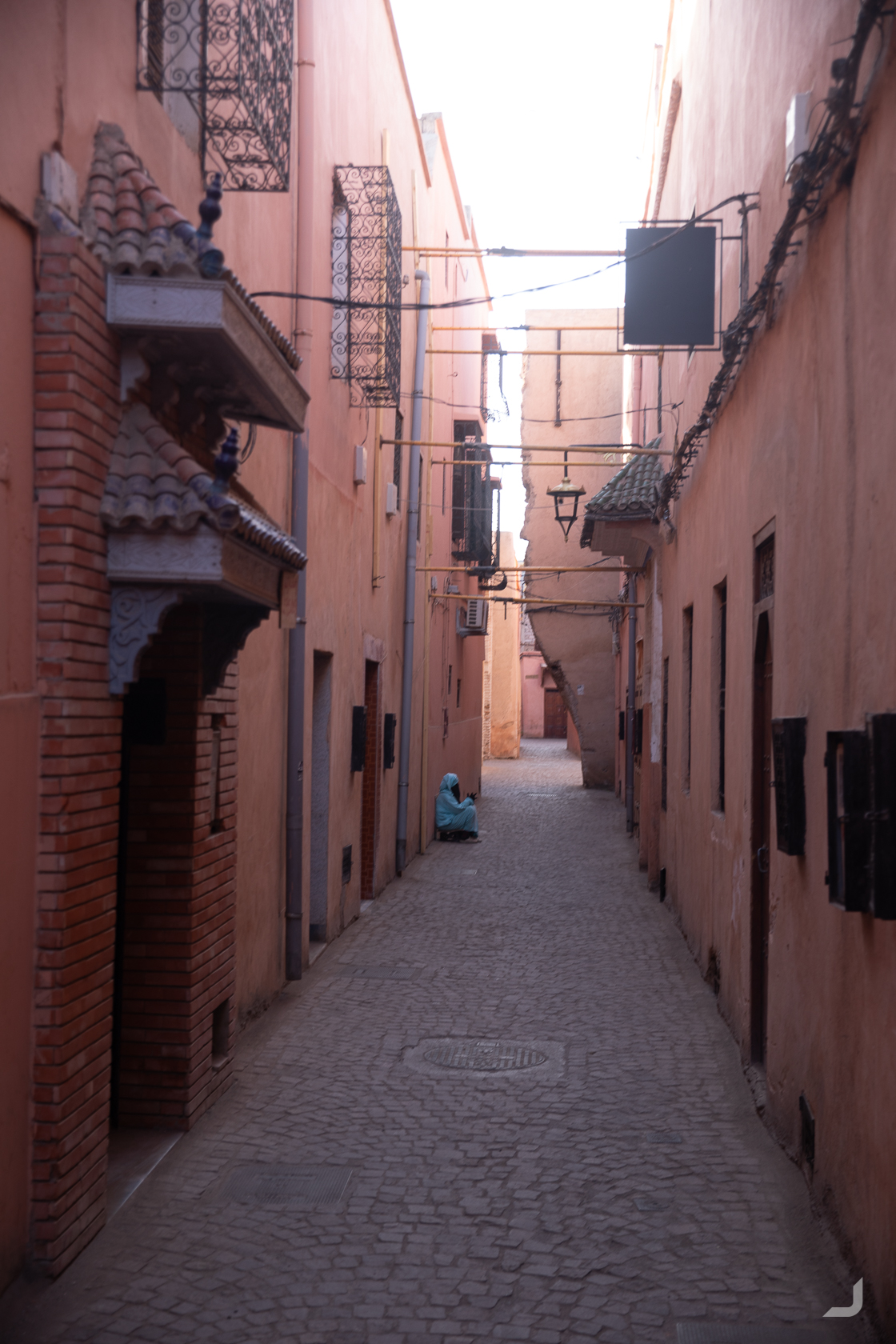

Locals inside the medina in Essaouira.

A palm tree grows between the walls of the medina in Essaouira.
Imlil
إمليل
Imlil is a town in the High Atlas that is often used as the base town for starting the climb of Jebel Toubkal, the highest mountain in North Africa (4,167m). It is only one or two hours drive from Marrakesh.
Sharing a taxi
While looking for a tour to join, I found a group of about a dozen Moroccans who were going to ascend mount Toubkal over 3 days and 2 nights. They still had a spot available, however their pick up time from Marrakesh was rather late at night so I asked if I could travel to Imlil on my own during the day.
While looking for the right taxi stand to Imlil, I bumped into 3 guys who were also heading to Imlil to climb mount Toubkal: a Frenchman, a Canadian and an Englishman. The Englishman had no phone and traveled solely by using his travel guide and by talking to people.
Keep in mind that the taxis won’t leave until it’s full, so we had to wait for a 5th person to join. In some cases this can take a while.


Views of Imlil from a short trek (the Imlil loop) in the nearby hills.
Jebel Toubkal
توبقال
The Moroccan tour group arrived in the early hours of the morning so it had been a wise decision to get to Imlil on my own earlier. Now that they were here it was time to start the ascend, first through various Amazigh villages until the landscape started to become more barren and steeper.

The view of Imlil from the start of the trek towards Jebel Toubkal.

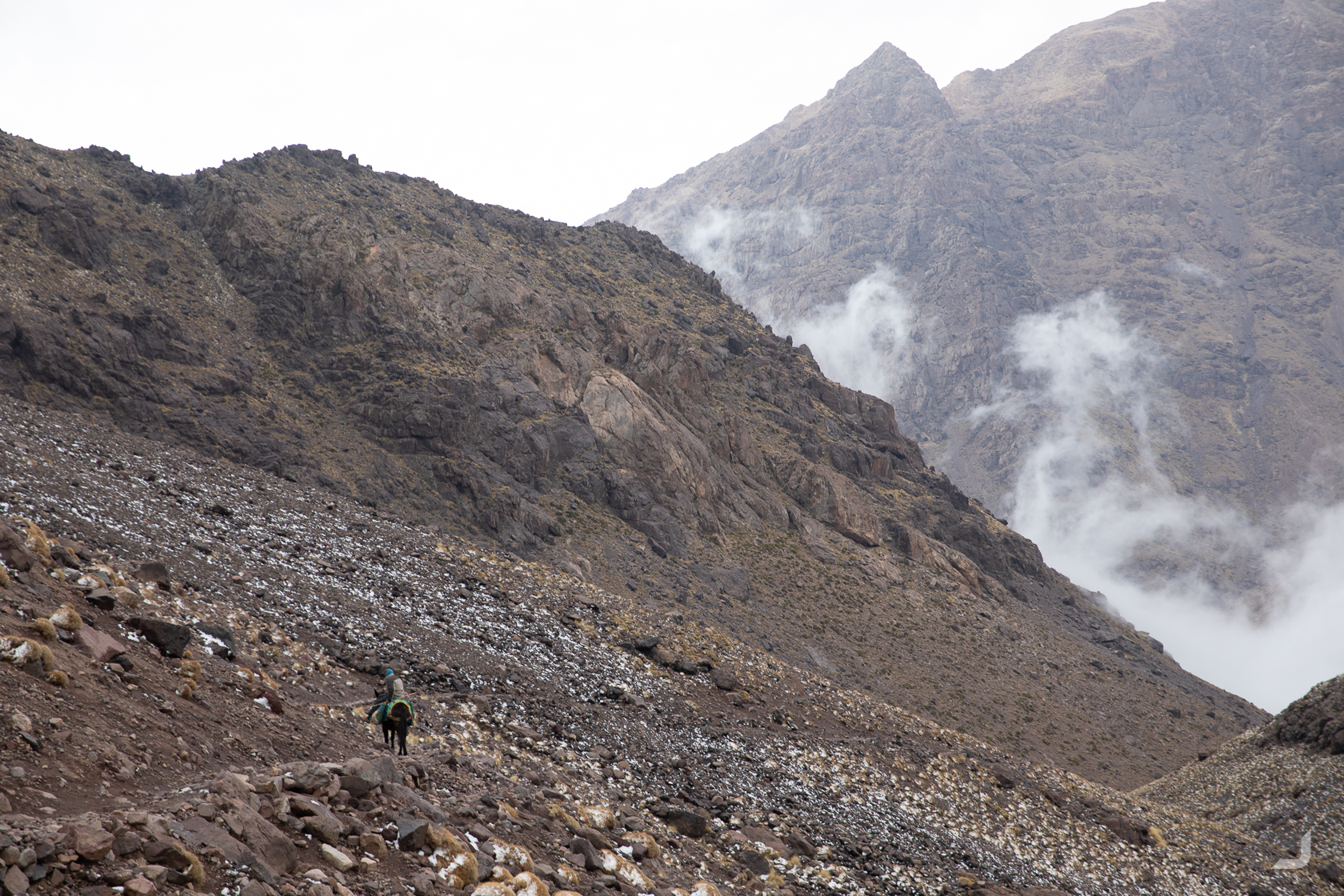
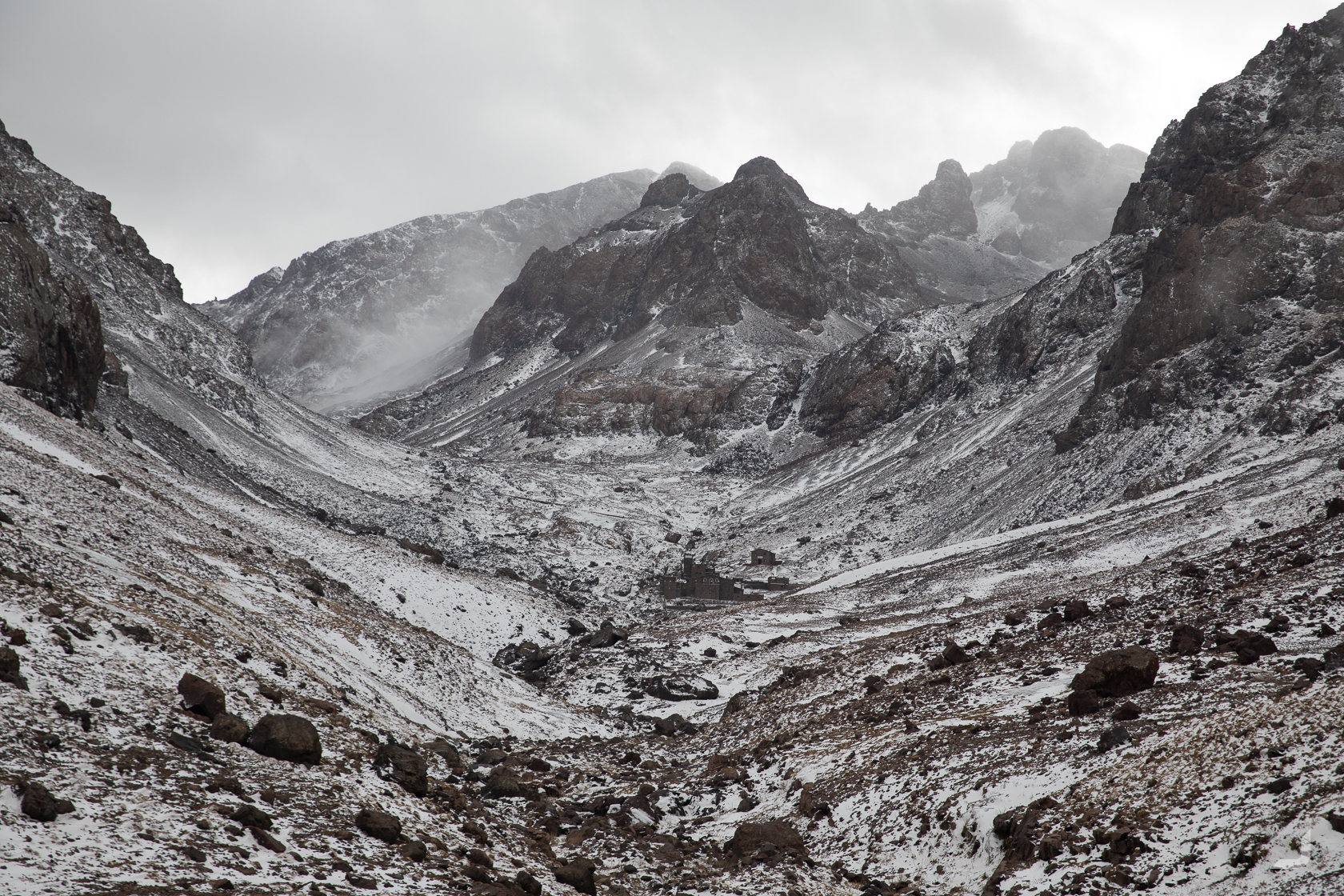
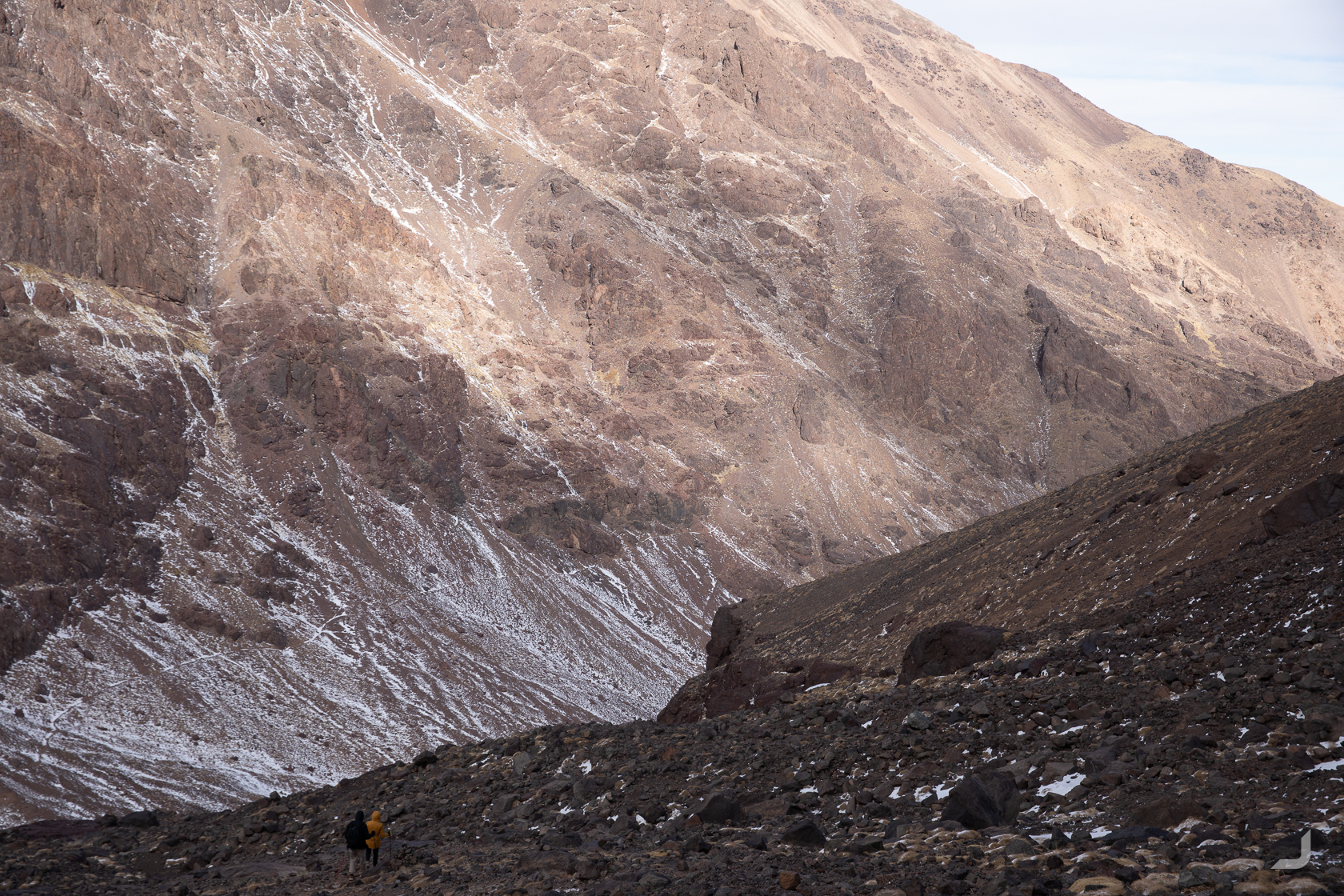
Horses are frequently used for transport (above). The image in the bottom left shows Refuge du Toubkal where we slept overnight before ascending to the top.
“You can’t climb a mountain on cookies”
Even though joining a tour group of 13 Moroccans can be a lot of fun, a downside is that I solely depend on the memory of the few who do speak English to remember to relay important information from the operators. One such detail I had missed was that you’d need to book your dinner in the refuge well in advance. They did have cookies so I braced myself for a high energy not so nutritious meal. Then I felt a tap of my shoulder, it was the Englishman that I had shared the taxi ride with. He and the other two guys had ordered their dinner on time and they had split their food so that there was also enough for me. Their reasoning was: “you can’t climb a mountain on cookies”. Maybe you can, maybe you can’t, but I do know that I was very grateful that I didn’t have to find out.
We got up at 3am in the morning to start walking at 4am. The trek is not difficult but has a fairly high inclination continuously for several hours. We made it just before sunrise around 8am.
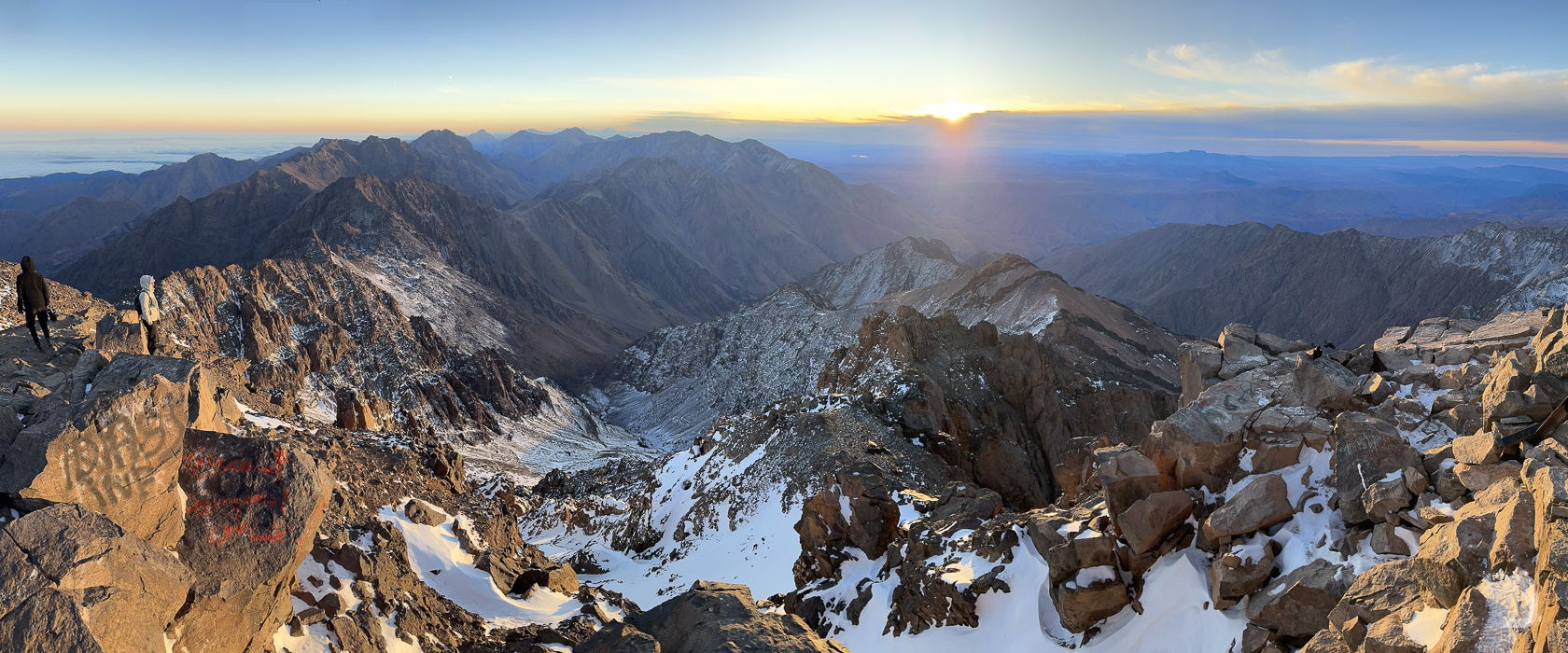
The view from Jebel Toubkal at sunrise.
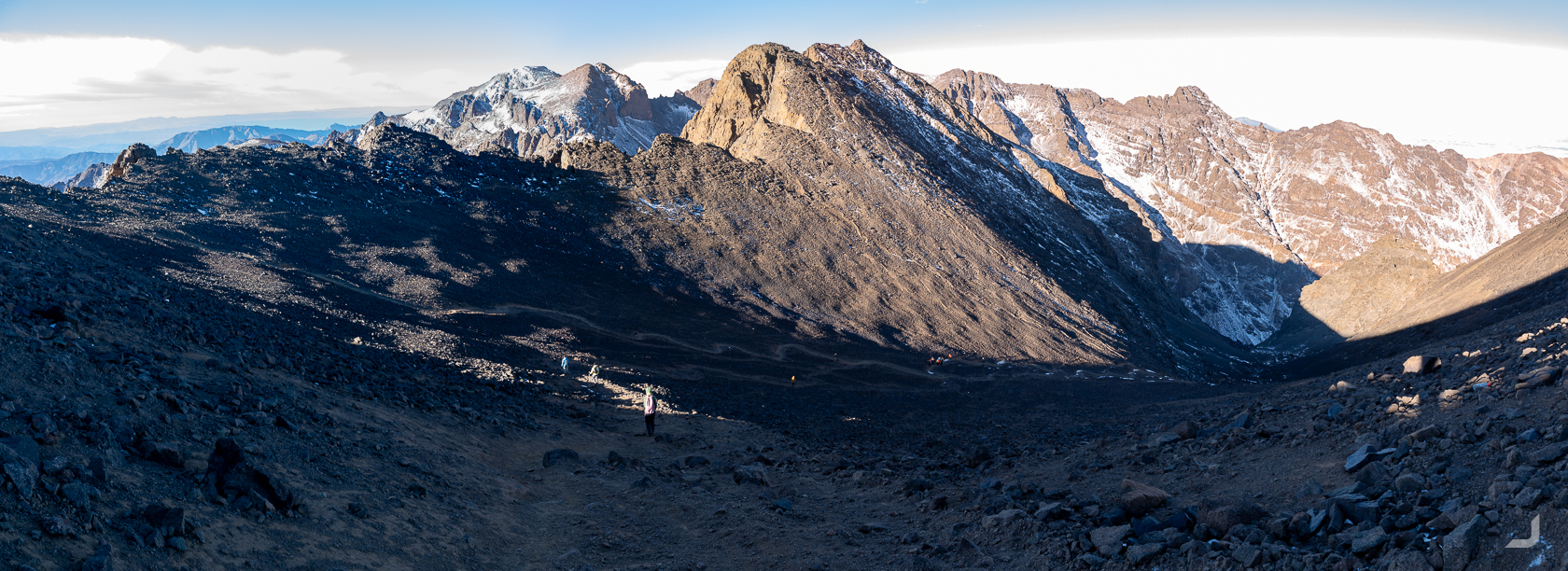
The view a few minutes down from descending Jebel Toubkal’s peak.
After a karaoke and games filled (of which I couldn’t understand a word) bus ride back to Marrakesh, I was wondering whether to visit Rabat or Casablanca in addition to Fes and Chefchaouen further north. Unfortunately, I had only the time left to visit one of the two. I threw it into the Toubkal hiking group and they all said the same thing: Rabat.
Rabat
الرباط
Rabat is the capital city of Morocco and is home to several UNESCO World Heritage Sites. It is also the seat of the King of Morocco and the location of important government bodies.


A woman walks through the medina (left) in Rabat. The medina was built in the 17th century and has a strong Andalusian influence, reflecting the heritage of Muslim and Jewish refugees who fled Spain during the reconquista.

The lighthouse in Rabat (منارة الرباط) during sunset.
Chefchaouen
شفشاون
Chefchaouen, the “blue pearl”, kept popping up everywhere as a must see in Morocco. Everywhere you go inside the old medina, you’re looking at a real-life postcard. The blue walls create a serene and almost surreal atmosphere, making the town one of the most visually stunning places in Morocco.
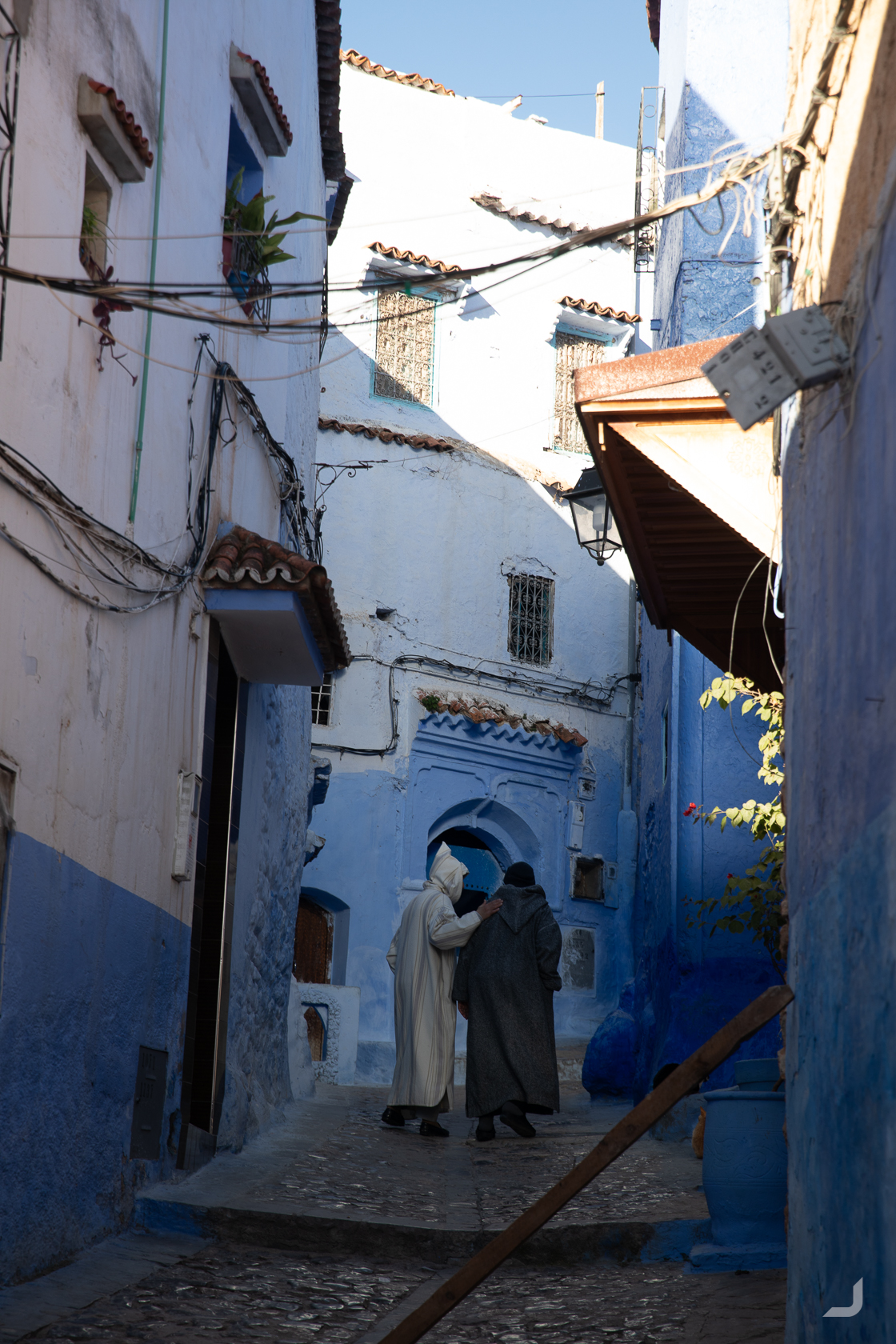

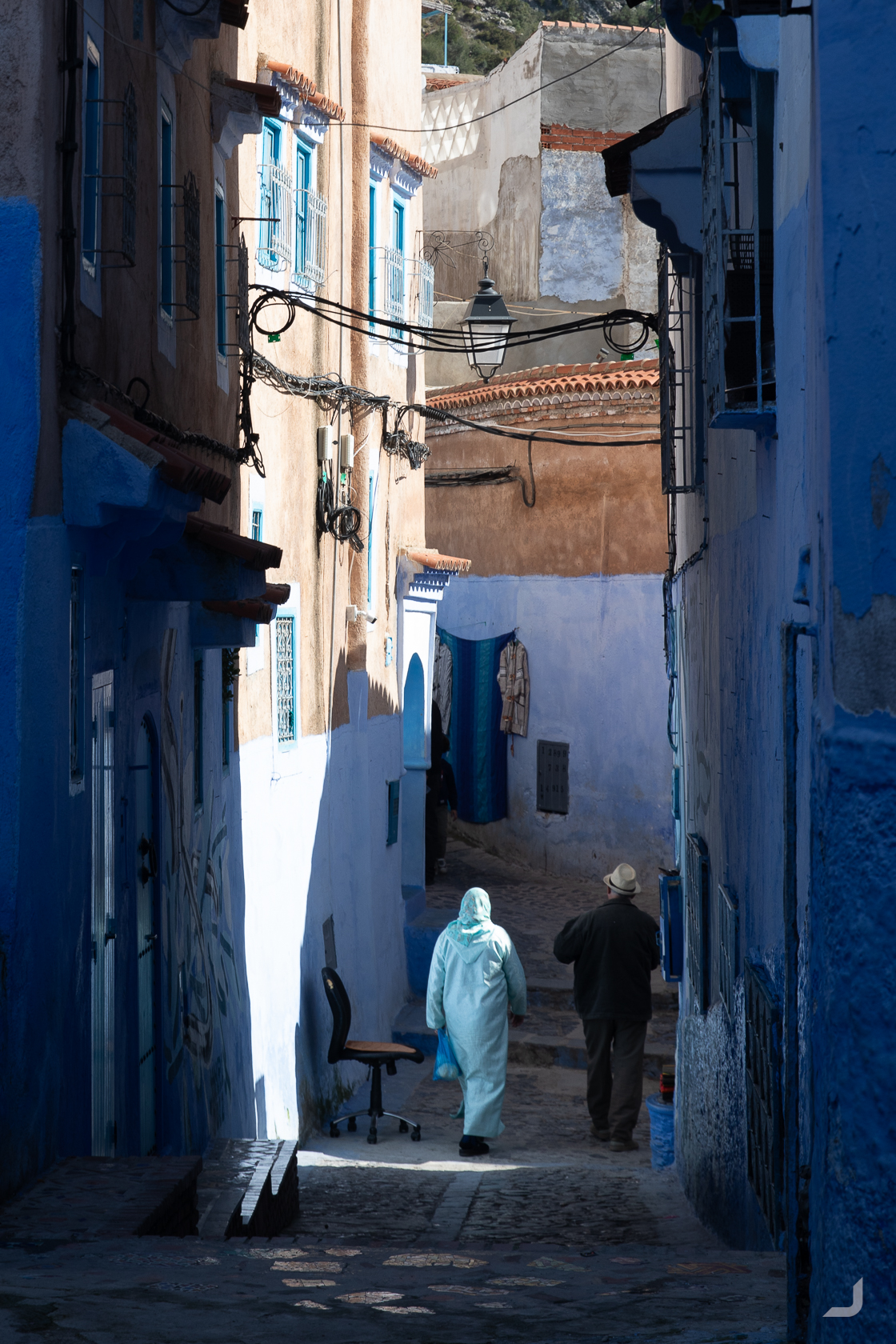


Chefchaouen, with its mostly blue painted walls, looks like a town out of a fairy tale with its picturesque lanes and houses.

An elderly lady rests on one of the blue stairs inside the medina in Chefchaouen.
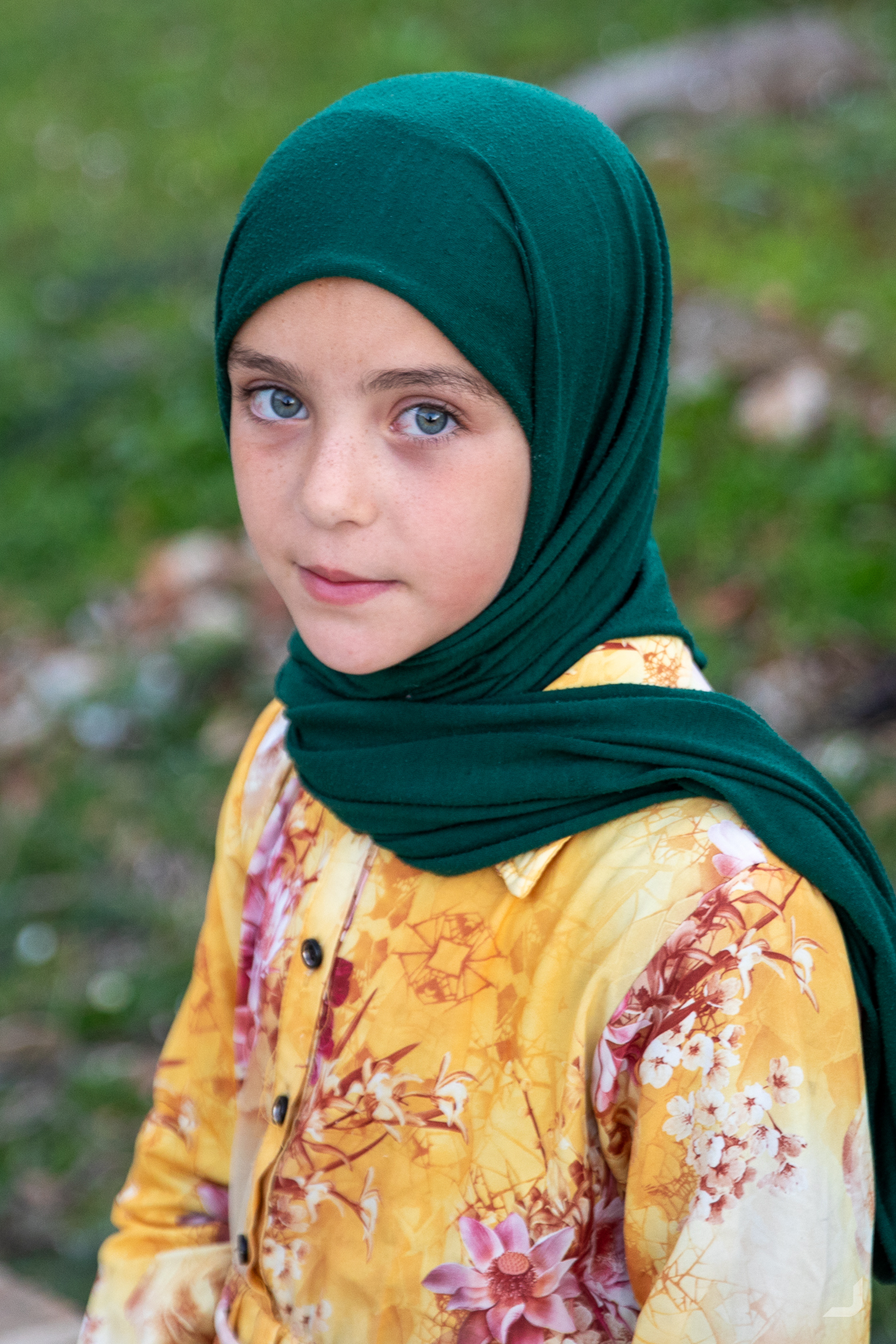
This young lady was selling cookies alongside the path that leads to the Bouzafer Mosque, which also has a stunning view of Chefchaouen. I asked if she was okay if I took a photo of her (as I was struck by her bright blue eyes) and she approved enthusiastically. As a thank you I bought a cookie, which put a smile on her face that I wish I had captured too.
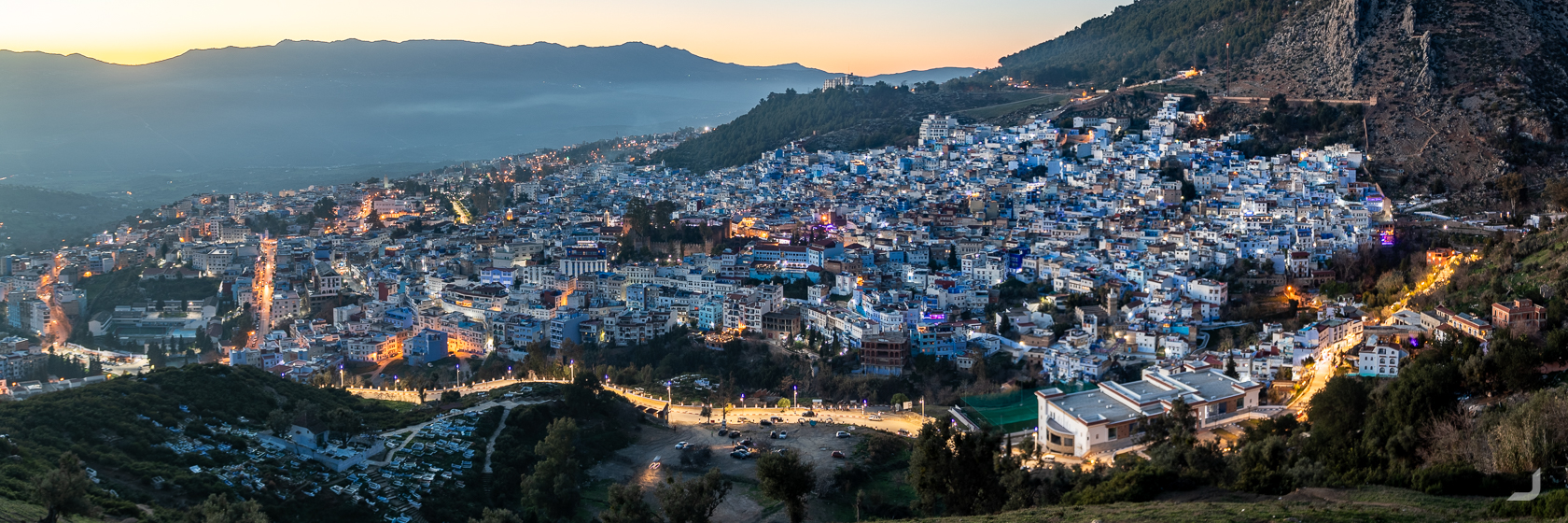
The view of Chefchaouen at sunset from the Bouzafer Mosque.
“Are you tall?”
When I entered my hotel in Chefchaouen, there was no reception to help me check in and a cleaning lady helped me find the keys and settle in. Soon after, I met the first person thus far (in my life) who knew my home town, as he came from a nearby city that is also the birthplace of my mum. Suddenly a guy came rushing in, nervously looking around asking us questions in Arabic. When he realised we didn’t speak any Arabic he typed something on his translator app, which he gave to the other Dutch guy. He read it out loud while he showed me the text, it said: “Are you tall?”. He read it being irritated and annoyed by the question but I thought it was the most hilarious and profound question that I’ve ever heard. He didn’t know how to answer it, but it didn’t matter as the man quickly disappeared.
My most logical (and perhaps most boring) theory is that he was looking for me to make sure that I had checked in and had received the keys.
Fes
فاس
The medina of Fes, known as Fes el-Bali, is the oldest and largest intact medieval city in the world. It is a UNESCO World Heritage Site and is home to over 9,000 narrow, winding streets and alleys, many of which have remained unchanged for centuries.
It is also famous for its leather tanneries, especially the Chouara Tannery, where they clean and soak the leather for its final colour and texture.

In the Chouara Tannery in Fes, the white vessels are for cleaning whereas the brown vessels will give the leather its final texture and colour.

An artisan craftsman at work inside the Chouara Tannery in Fes.

The Chouara Tannery is a very popular destination for Instagrammers.

The outside of a residential building gives a peak into local life in Fes.

The first half of this photo is the minaret of the Bou Inania Madrasa, while the other half is the view over the northern part of Fes.
After Fes, it would have been the end of my Morocco trip. However, in Essaouira I ran into a close friend who suggested that I should really meet someone in Marrakesh who runs a local foundation called Action Autonomy Future (AAA). There was potential for AAA to be a great candidate for my Fair Photo project, where funds from photo prints sold are channeled back to local initiatives in the areas where the photos are taken. I contacted him and the only time we could both make it was on my final night in Morocco.
Then it turned out that on that same final night, another friend arrived in Morocco. She was interested to come along to the meetup and I pitched the idea to both of them. The head of AAA, Patrick, appeared impressed with the idea and he was keen to send me to local villages to document their activities right away. There were only two problems: I don’t speak French and I was supposed to leave the next day. Changing the flight turned out to be affordable and my friend happened to speak French. She was happy to join and one of the most adventurous weeks of my life followed.
The following images and short accounts are taken and written from my own perspective and experience as a traveler, rather than as an Fair Photo journalist. Detailed blog posts about the foundation and their activities will be posted on the Fair Photo website.
Tizi-n-Ouchchag
The first stop was Tizi-n-Ouchcheg, a small village that took us a couple of hours to hike to from our drop-off point at the main road. It was badly struck by the earthquake in the High Atlas in 2023. In addition, the climate is getting warmer, water is getting scarcer and young people tend to leave to the cities for a better life.
We spoke with Nordine from the local Association Tizi N’oucheg Développements (in association with AAA), a local organisation that supports the village with access to clean water, education, tree planting and other activities. Read more about this soon on the Fair Photo website.

A man passes on his donkey nearby Tizi-n-Ouchhag.
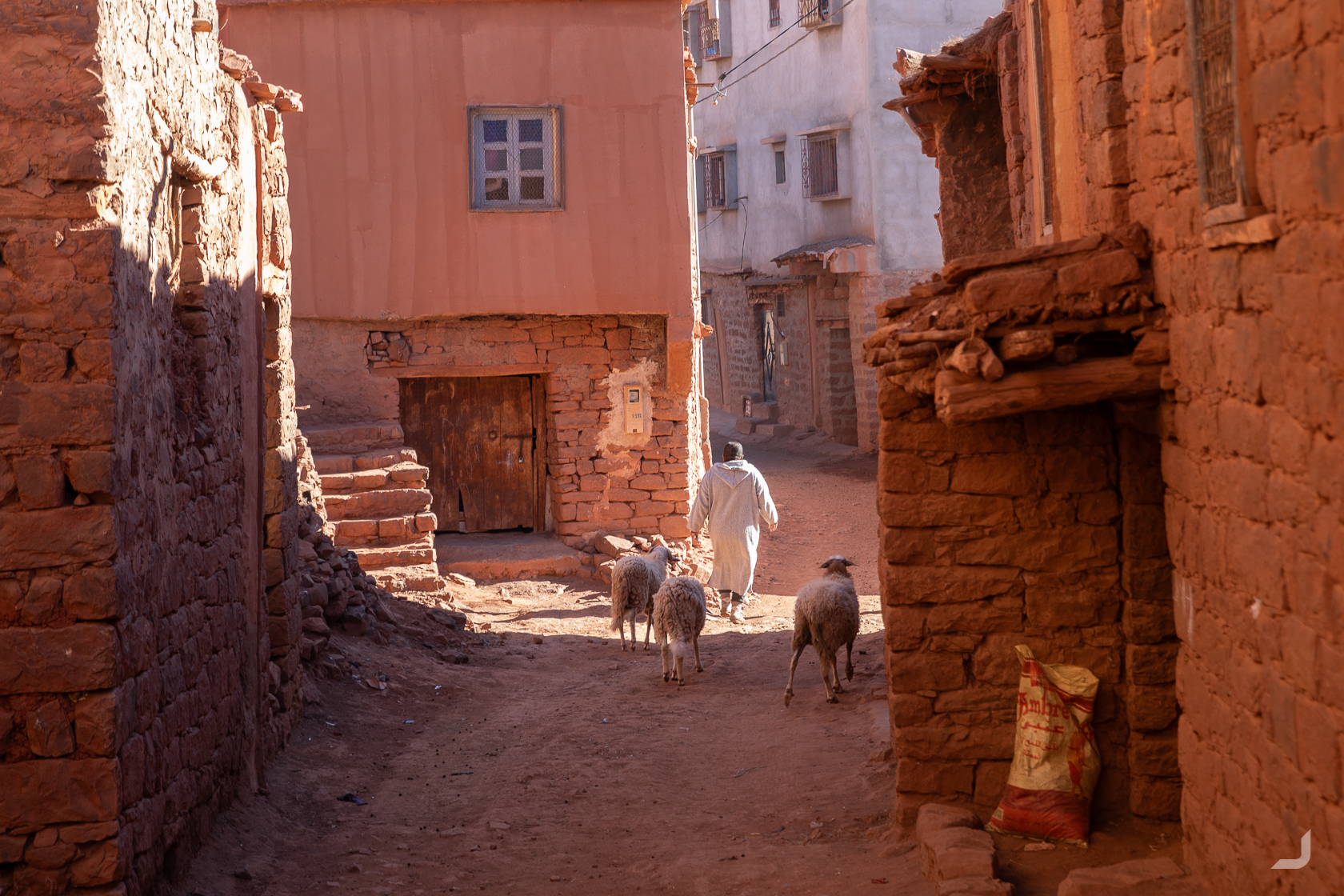
A man leads his sheep through the inner town of Tizi-n-Ouchchag.


Setting sun behind Tizi-n-Ouchchag.

A panoramic view of Tizi-n-Ouchchag at sunset.

Tizi-n-Ouchchag is nearby the Plateau de Yagour, a rugged mountainous area in the High Atlas.
Sky wells
فتحة السقف
Riads (homes) and kasbahs (historically significant buildings that served both as residences for rulers or tribal leaders and as defensive strongholds) in Morocco often have an inner courtyard that has an open ceiling called a sky well (or light well) that brings natural light to the lower floors.
The air flow from the opening also helps to keep the lower floors cool during the day and and warm during the night. The kasbah below in Timiderte has had students visit from Europe to study the building.
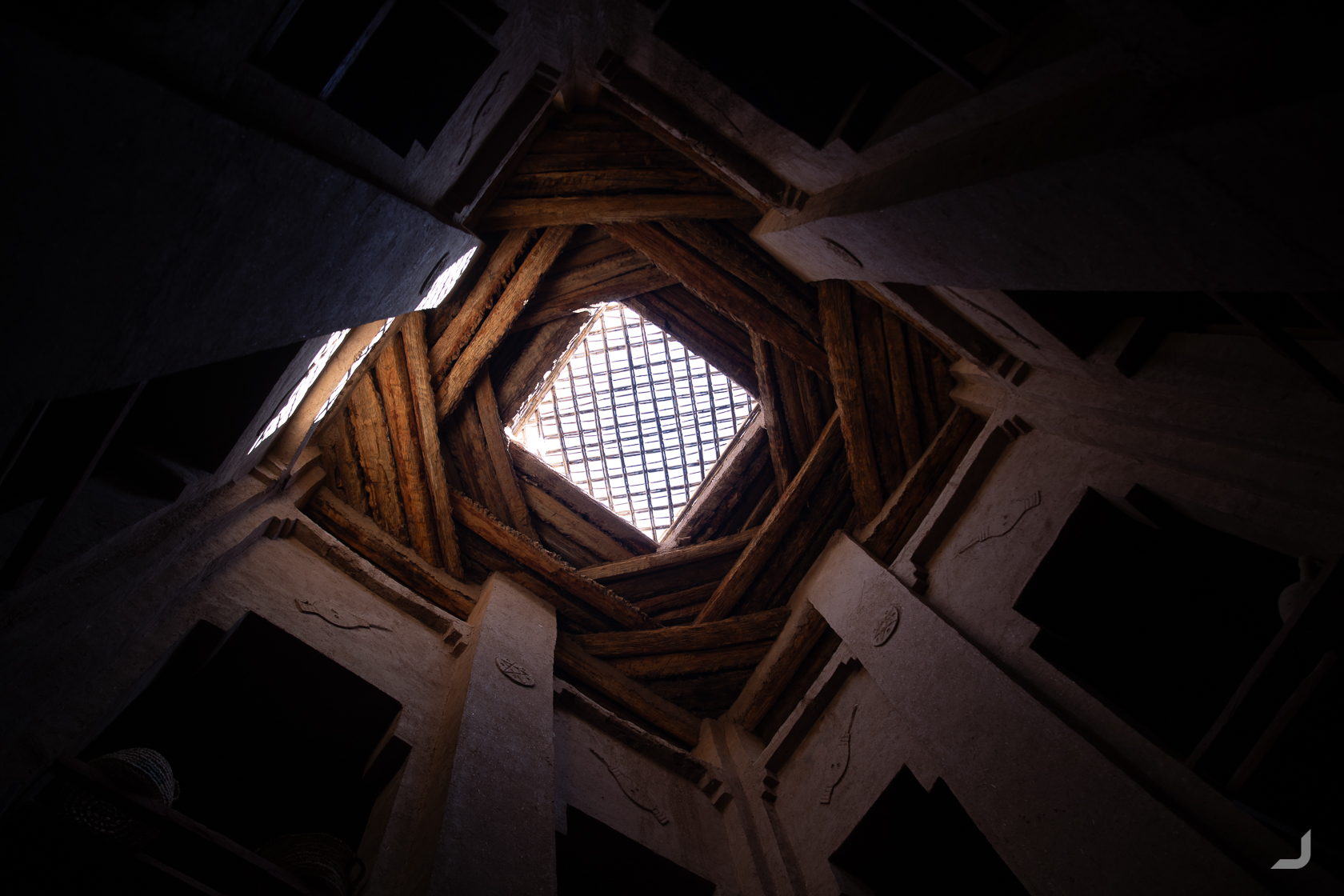


Sky wells from below. The first kasbah in Timiderte (above) was used in several movies, including The Sheltering Sky, Prince of Persia, Babel and the English Patient. The bottom two images on the left are taken from inside the Royal Theatre where we were kicked out as it wasn’t open to visitors (even though the guard let us in). The bottom right image was taken inside a Kasbah in Tamnougalt. In Arabic, these openings are referred to as “فتحة السقف” (pronounced “fathat as-saqf”), which literally translates to “roof opening”.
In traditional Moroccan architecture, this opening plays an important role in bringing natural light and ventilation into the central courtyard of the riad. It helps to illuminate and ventilate the interior spaces as kasbah’s are surrounded by a fortified wall.
Agdz
أڭدز
Agdz is located at the head of the Draa Valley, one of Morocco’s largest oases and on the ancient caravan route between Marrakech and Timbuktu. Agdz in Tamazight means “resting place”, as it was frequently used as a stop over for the trans-Saharan trade caravans.

Jebel Kissana behind walls made from clay and straw alongside the Draa river in Agdz.
The valley is now known for date production, but also produces crops like wheat and vegetables. It is highly dependent on the Draa river that was completely dried up when we were there. Normally the river flows more strongly during the winter and spring when rain and melted snow from the High Atlas Mountains feed into it.

Entire cities and towns, called “ksars”, are completely made from clay, wood, straw and reflect traditional Amazigh architectural styles. These clay structures are excellent for regulating temperature; they stay cool during hot days and retain warmth during colder nights. All materials are local and biodegradable. A major downside is that they require a lot of maintenance, which is slow and labour intensive.


Jebel Kissana rises behind the oasis in Agdz.
Timiderte
Timiderte is home to well-preserved kasbahs (fortified homes or castles) and ksars. Many of these kasbahs are still inhabited and provide a glimpse into life as it has been lived for centuries.
We spoke to Nicolas who works with an organisation called “Jebel Kissane”. The organisation helps to restore the communal structures inside the ksars.
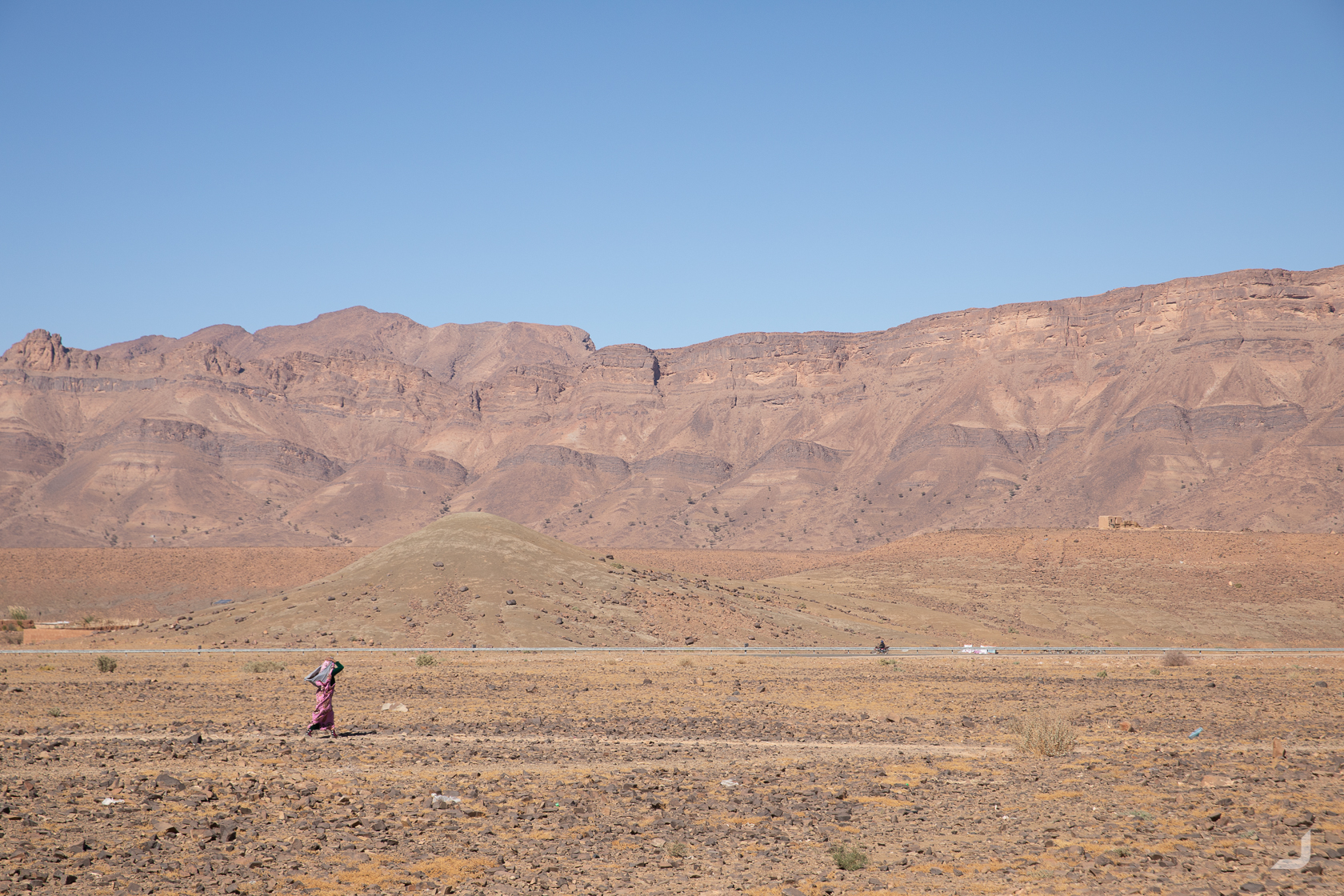
A woman carries items from a nomadic village located nearby Timiderte.

A man cycles into Timiderte at the foot of Jebel Kissane.

A man rides a donkey alongside a kasbah inside the ksars of Timiderte.

When entire towns are made out of clay, they require a lot of maintenance. If not, rain will erode walls and structures, leading to damage and cracks.

A donkey stands amidst the ruins of the ksar in Timiderte.
The Old Mosque
The Old Mosque (المسجد العتيق تميضرت) is one of the few mosques in Morocco that is open to non-muslims and it is the only one that can be visited that is located inside a ksar. The mosque was abandoned around the mid-nineties and is being restored by “Jebel Kissane”, together with other public spaces, to preserve ancient techniques and to educate contemporary students and visitors.
In the words of Nicolas, “the civilisation had come up with their own solution that is very different from modern culture” and they were “masters in creating natural ventilation and in directing the light that comes in”.


The partly restored interior of the Old Mosque (المسجد العتيق تميضرت) inside the ksar in Timiderte. It is being restored by the organisation Jebel Kissane.
As with Tizi-n-ouchchag, there is also a high degree of people migrating from Timiderte to the big cities, contributing to the decay of the ksars.
Even though the ksars have significant cultural and historical value, according to Nicolas the maintenance and care of these structures is currently not as important to the local people as they have greater economical challenges. However, as time passes it’ll become more difficult for these structures to be restored.


One of our hosts, Abdou, took us into his home and showed us how they prepared food. Common Moroccan dishes are tagine and cous cous (which is likely also the name of the local cat).
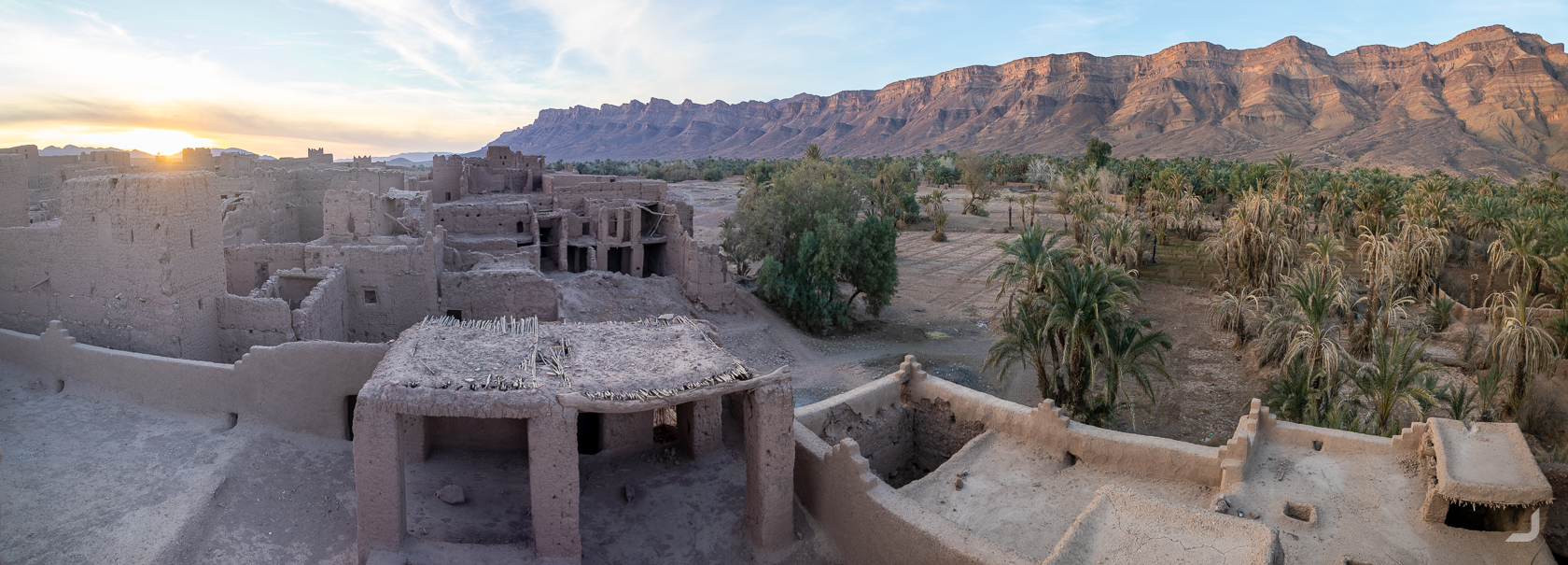
The view of the ksar, the oasis and Jebel Kissane from a rooftop in Timiderte.

Palm trees rise from the oasis at Timiderte.

A typical lane inside the ksars in Timiderte.

A beehive (the large black hole underneath the pipe sticking out) that is located inside the wall allows the residents to get easy access to honey.

The view of a window inside a kasbah in Timiderte.

The rooftop of on old and tiny mosque that has not yet been restored inside the ksar in Timiderte.
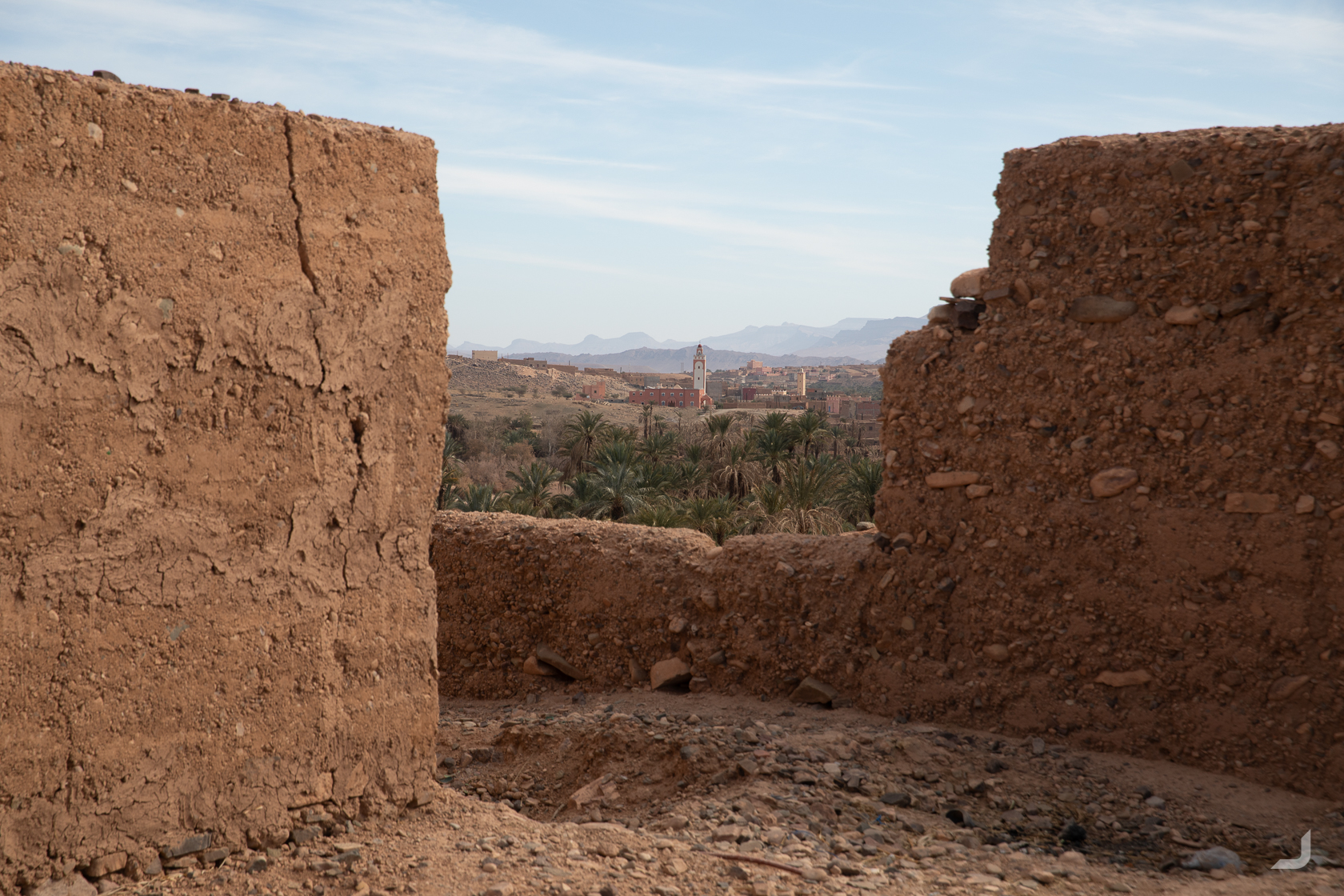
The view of Ait Hammou Ou Said from between the walls of the ksar in Timiderte.
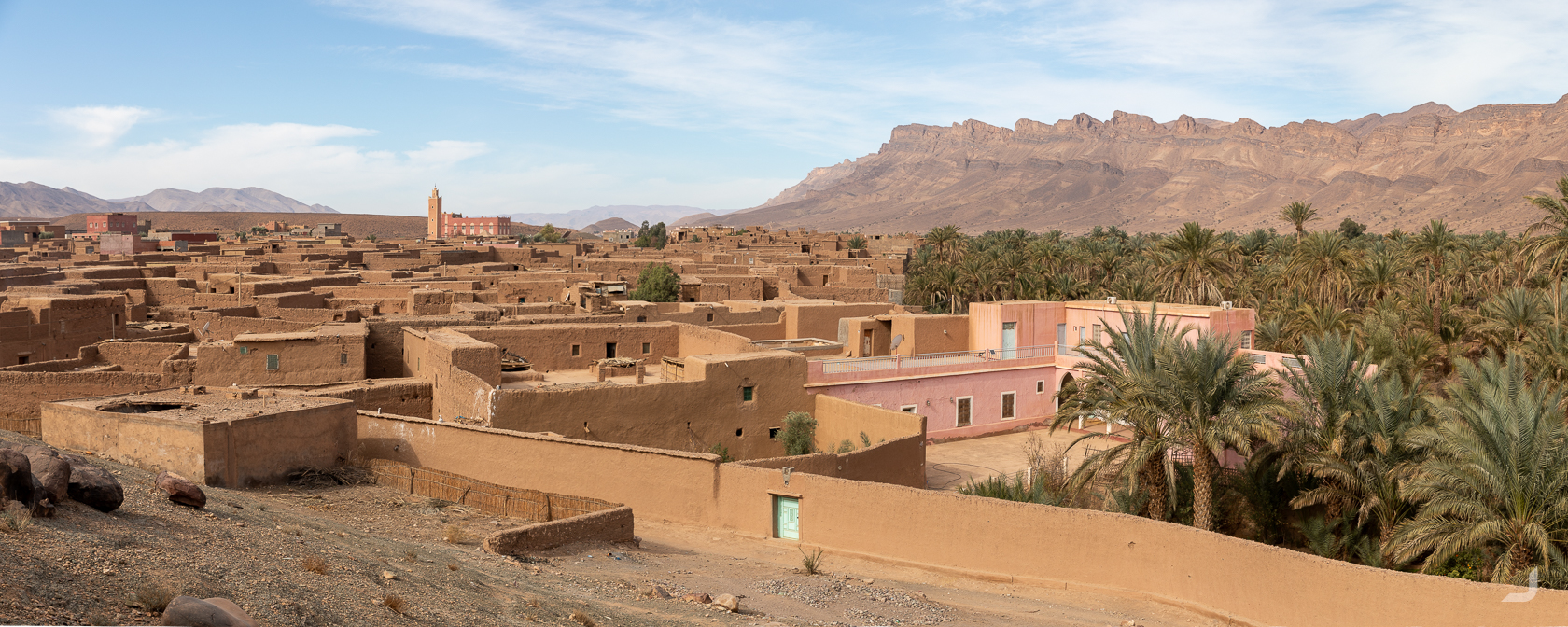
Timiderte’s ksar and oasis, in front of Jebel Kissane.
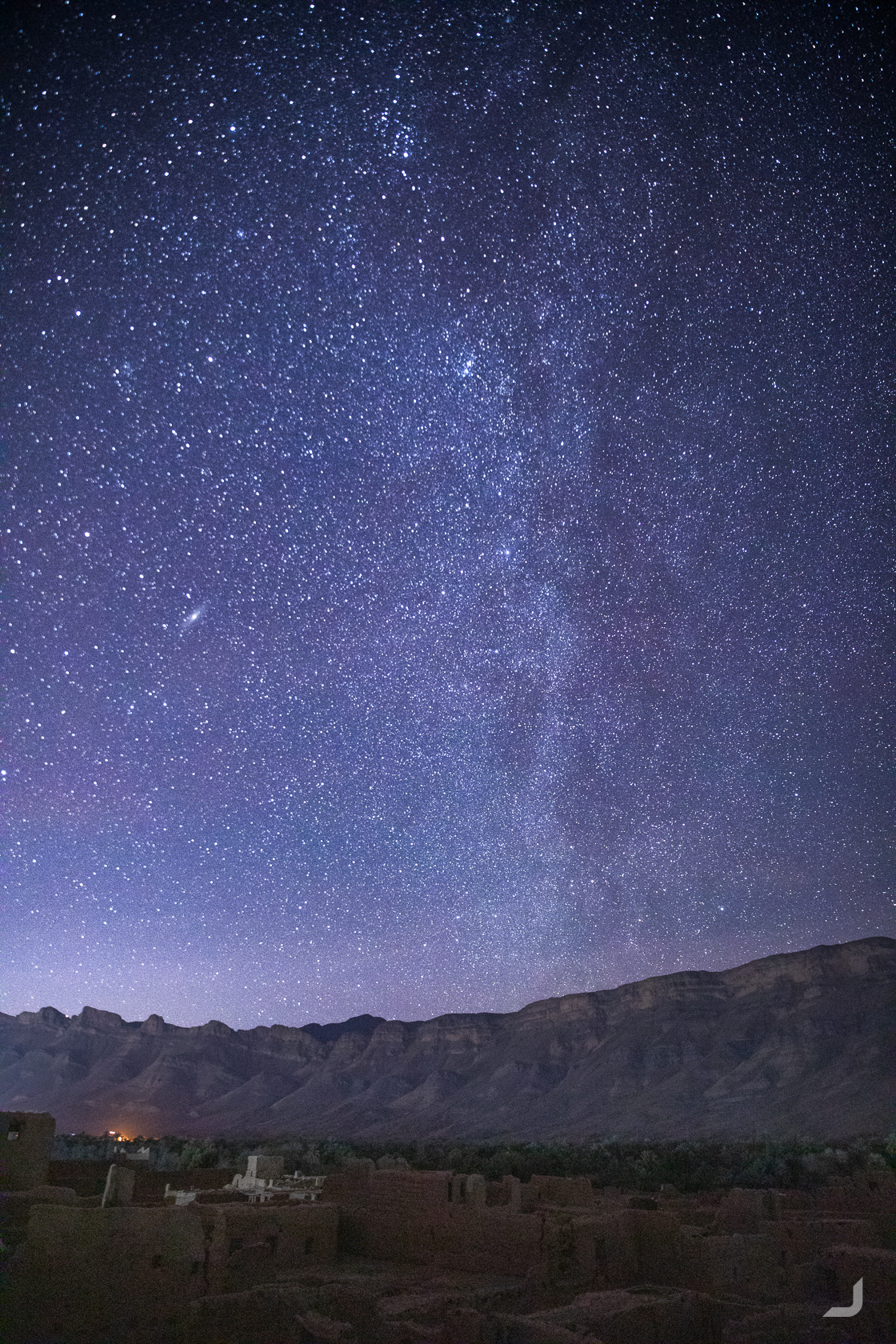
The night sky above Jebel Kissane and Timiderte.
Tamnougalt
قصر تامنوكالت
After Timiderte, there was only time to visit one more village: Tamnougalt. Tamnougalt is a quintessential example of a traditional Amazigh village and is home to a kasbah that is one of the oldest and most well-preserved kasbahs in the Draa Valley. It was once the seat of the powerful local Glaoui family, who were influential leaders in the region.

The ancient ksar at Tamnougalt.
While we hitchhiked from Timiderte to Tamnougalt (as a testament to some of the local hospitality, the very first car we tried stopped immediately), we walked back to Timiderte alongside the completely dried up Draa river. It should not be dry this time of the year and demonstrates the significant problem of water shortage.
Tamnougalt, Tizi-n-ouchchag, Timiderte, Jebel Kissane, a nearby nomadic village and many more villages are all supported by AAA. In addition to restoration, the foundation also helps with the provision of clean water and education.
Even though Morocco has been so far one of the most challenging places to photograph and the atmosphere is often tense, it has also been one of the most intriguing, layered and photogenic. Moroccans don’t seem to like journalists snooping around very much and me not being Moroccan, holding a big camera, asking questions just didn’t make friends that easily. However, as with most places around the world, but I think especially with Morocco, it might pay off to learn a little bit of any of their local languages and to be patient. Their insanely rich history deservers no less and all that might be in between judgement and understanding (and even respect) is a little bit of mutual curiosity.